Skip to content

Sixty percent of small business owners regret a software purchase within 18 months. CRM is the number one culprit.
I've spent six years testing business software for Softbliq.com. I know exactly where the traps are. So I personally tested the ten most popular CRM platforms — real accounts, real pipelines, real workflows — to find the best CRM software for small business in 2026.
No filler. No paid placements. Just an honest breakdown so your team doesn't waste the next 18 months on the wrong tool.
What Is the Best CRM Software for Small Business in 2026?
The best CRM software for small business in 2026 depends on what you actually need:
- HubSpot has the strongest free plan and the best all-around ecosystem
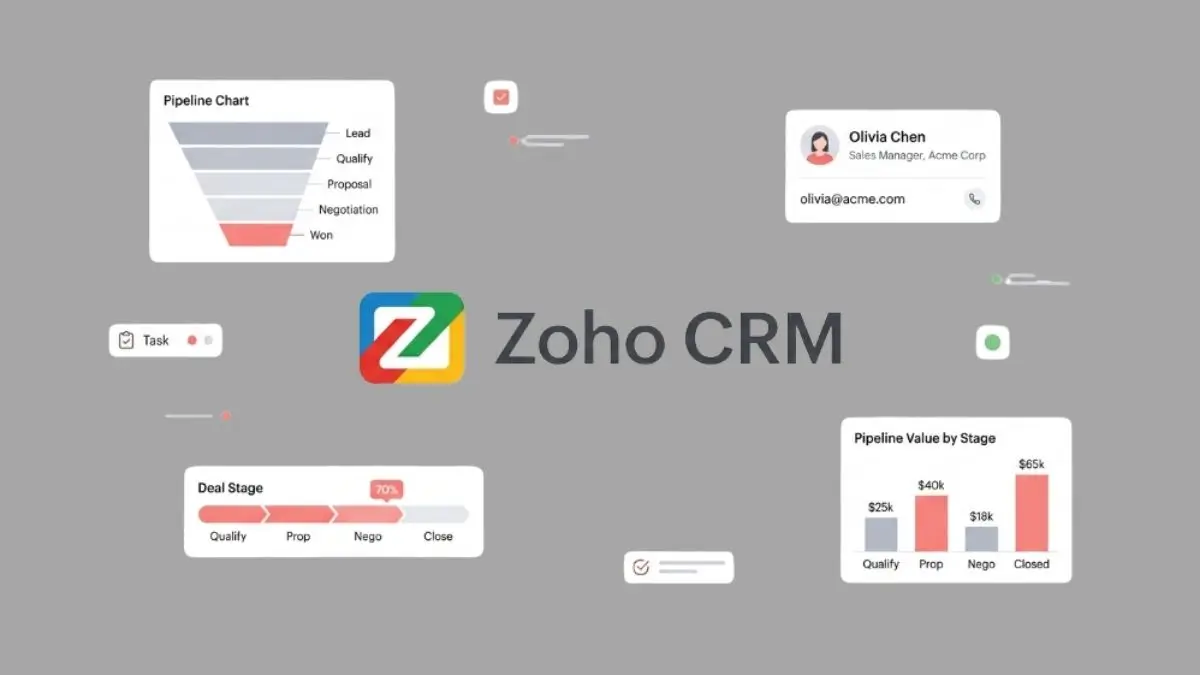
- Zoho CRM delivers the most features per dollar
- Pipedrive is built specifically for sales teams who live in their pipeline
If you're in a hurry: HubSpot's free plan is the safest starting point for most small businesses. If you already have a dedicated sales team, go straight to Pipedrive. If budget is the deciding factor, Zoho CRM gives you more features per dollar than any other option on this list.
Below I break down all ten tools — including the real pricing, the real trade-offs, and the honest user sentiment you won't find in a feature comparison table.
How Did We Test and Choose These CRM Tools?
Let me be direct: this isn't a list built from affiliate payouts or press releases.
I signed up for a real account in each tool. I built a test pipeline. I imported sample contacts. I ran automations. I tested mobile apps on both iOS and Android. Then I cross-referenced my findings against thousands of verified reviews on G2 and Capterra to catch patterns I might have missed.
My evaluation criteria for the best CRM software for small business in 2026:
- Ease of setup — can a non-technical founder get going in under 60 minutes?
- Real 2026 pricing — not the teaser rate, but the actual cost after year one
- AI and automation quality — what does it actually do versus what it claims?
- Integration depth — Gmail, Outlook, Slack, and Zapier connections that actually work
- Mobile app usability — because your team works on the go
- Honest user sentiment — I specifically looked for recurring complaints, not just star ratings
What Features Should Small Businesses Look for in CRM Software?
Before you look at any specific tool, you need to know what actually matters. Here's the shortlist.
Contact Management and Pipeline Visibility
Your CRM's first job is simple: never let a lead fall through the cracks. You need clear deal stages, activity history for every contact, and a pipeline view that tells you at a glance where each opportunity stands. If you have to dig for that information, you'll stop using the tool within a month. A common mistake I see is small businesses buying a CRM with fifty features when they only need three. Start with pipeline visibility and contact history. Everything else is bonus.
Automation and Workflow Tools
This is where most small businesses leave money on the table. Even basic automation — a follow-up email three days after a meeting, a task assigned when a deal moves to "Proposal" — saves your team hours every week.
Here's the thing: most free plans lock automation behind paid tiers. Know what you need before you commit. If you're a solopreneur, you probably don't need complex workflows yet. If you're a team of five, you absolutely do.
Integrations (Gmail, Outlook, Zapier, Slack)
The best CRM for a small business is the one your team will actually use. If it doesn't connect to your email client natively, adoption will die within thirty days. Check the quality of Gmail and Outlook integration before anything else. A CRM that lives in a separate tab your team has to remember to open will fail. Period.
AI and Smart Features in 2026
Every major CRM now ships with some form of AI. But there's a massive gap between HubSpot Breeze AI — which genuinely helps with email generation and deal insights — and a basic "smart suggestion" that tells you to follow up on a lead you already closed. I'll score each tool's real AI capability below.
Pricing Transparency and Total Cost of Ownership
Advertised price does not equal actual price. A "$14/user/month" plan for a five-person team costs at least $840 per year. Add contact tier upgrades, required add-ons, and onboarding fees, and you're often looking at two to three times that figure by month twelve.
I'll break down the real twelve-month cost later in this article. It's the section no competitor writes, and it might be the most valuable thing you read today.
What Is the Best Free CRM for Small Business?
Five tools on this list offer a genuinely free tier — not just a trial. Here's what "free" actually gets you in 2026.
HubSpot CRM (Free Forever)
Free forever. Unlimited users. Up to 1,000 contacts. Includes deal pipeline, email tracking, meeting scheduler, and live chat. No credit card required. The catch: marketing automation and sequences require a paid Hub. For most small businesses just getting started, this is the best free CRM on the market.
Zoho CRM Free (Up to 3 Users)
Free for up to three users with leads, contacts, accounts, and deals included. Storage is limited, and customer support on the free tier is slow. Worth it as a starting point if you're under three people and willing to spend some time learning the interface.
Freshsales Free Tier
Free for up to three users, including contact management, a visual pipeline, and a mobile app. Freddy AI is not included on the free plan, but basic pipeline management is solid for a brand-new team. Setup took me under 45 minutes.
Bigin by Zoho (Free Solo Plan)
Free for a single user. Perfect for a solopreneur who wants a real pipeline — not a spreadsheet — without spending a dollar. When you hire your first employee, you'll need to upgrade to the $9/user Express plan. That's fine. That's exactly what the tool is designed for.
Salesforce Free Suite (2 Users)
Salesforce quietly launched a Free Suite for up to two users. It's very limited compared to paid tiers — no automation, no AI — but it gets you into the Salesforce ecosystem. Use it to evaluate the UX, not as a permanent solution.
When should you upgrade from a free CRM? Upgrade when: (1) you've hit the contact limit, (2) you're manually doing tasks automation would handle, (3) your team logs things inconsistently because everyone's on different free tools, or (4) you've lost a deal because of a missed follow-up. The moment a missed follow-up costs you real revenue, the free CRM has paid for itself many times over.
Which CRM Is Best for Your Business Type and Size?
Stop reading generic lists. Here's how to match the right CRM software for a small business to your actual situation.
Best CRM for Solopreneurs and Freelancers
→ Bigin by Zoho (free) or Less Annoying CRM ($15/mo)
You don't need automation or marketing tools yet. You need a place to track who you talked to, what you promised, and when to follow up. Both tools do this perfectly. Don't overthink this. Pick one, spend thirty minutes setting it up, and move on to selling.
Best CRM for Teams of 2–5 People
→ HubSpot (free tier) or Zoho CRM (free up to three users)
At this stage, getting everyone on the same system matters more than features. HubSpot's free plan handles this without any technical setup. Your team can be up and running in under an hour, and you won't pay a cent until you're ready to scale.
Best CRM for Teams of 5–25 People
→ Pipedrive or Freshsales ($9–$14/user/mo)
You've got active pipelines now. You need real reporting, deal-stage automation, and a mobile app that works. Both deliver at a reasonable price. Pipedrive is better for sales-driven teams. Freshsales is better if you want AI lead scoring without paying enterprise prices.
Best CRM for Service-Based Businesses (Agencies, Coaches, Consultants)
→ Keap ($249/mo) if you have the budget; HubSpot if you don't.
Service businesses need to automate the client lifecycle from lead capture to invoicing. Keap does this better than anyone. HubSpot gets you eighty percent of the way there at a fraction of the price. If you're just starting out, start with HubSpot and upgrade to Keap when you have the revenue to justify it.
Best CRM for Sales-Driven Businesses
→ Pipedrive. Period.
Salespeople built Pipedrive for salespeople. The visual pipeline is the clearest in the market, and the activity-based selling methodology is baked into the UX. Your sales team will adopt it faster than any other tool on this list.
Best CRM for E-Commerce Small Businesses
→ HubSpot (integrates with Shopify and WooCommerce) or Monday.com CRM (for teams managing both sales and fulfilment)
E-commerce businesses need CRM, marketing, and order history in one view. HubSpot's ecosystem handles this best. If you're managing both projects and sales, Monday.com's flexible board structure gives you one place for everything.
What Are the 10 Best CRM Software for Small Businesses in 2026? (Full Reviews)
Let's get into it. I tested each of these personally.
1. HubSpot CRM — Best Overall Free CRM for Small Business
HubSpot is the best starting point for most small businesses looking for CRM software in 2026. It offers a genuinely free-forever plan with unlimited users, and the setup takes less than an hour. The real value isn't just the free CRM — it's that HubSpot's entire ecosystem (marketing, service, CMS) is built around a single contact database, so you never have to start over as you scale.
Use case: Best for small businesses (1–10 people) moving off spreadsheets, especially if content marketing is part of your growth strategy.
Key Features
- Breeze AI: HubSpot's 2025-launched AI layer handles email generation, deal summarisation, and CRM data cleanup. It's available across all Hubs and genuinely saves time — not just a chatbot bolted on.
- Free contact management + deal pipelines: Unlimited users, customizable pipeline stages, email tracking, and meeting scheduler included at $0. The most generous free tier in the market.
- All-in-one ecosystem: Your CRM, marketing emails, landing pages, live chat, and customer service tickets live in one place. No third-party duct tape required.
Pricing
- Free trial: Free forever (no credit card required)
- Plans starting from $15/user/month (Sales Hub Starter)
| Pros | Cons |
|---|---|
| Cleanest onboarding experience of any CRM on this list | Automation and email sequences locked behind paid tiers — the free plan is a foundation, not a destination |
| Email tracking, meeting scheduler, and live chat are all included free of charge | Priced to upsell you into the full Marketing/Service Hub ecosystem; pure sales teams may overpay |
| Best-in-class content marketing + CRM integration | Contact limits on free tier can be restrictive for growing lists |
What Users Are Saying
"HubSpot's free CRM remains the most generous starting point in the market. If you're not using the free tier, you're leaving money on the table." — Sales professional, G2 Verified Review 2026
Softbliq Rating: 8.9/10 — Best Overall Free CRM
2. Zoho CRM — Best Value CRM for Small Business
Zoho CRM is the best CRM software for small business owners who want enterprise-grade features at a small-business price. It's not the prettiest tool on this list, but nothing else gives you this level of customisation — custom modules, fifty-five-plus native Zoho app integrations, and AI-powered lead scoring — for $14/user/month. If you're a growing team with a non-standard sales process, Zoho is your CRM.
Use case: Growing SMB (5–30 people) with a specific sales process that needs deep customisation on a tight budget.
Key Features
- Zia AI: Predictive lead scoring, email sentiment analysis, and anomaly detection built natively into the CRM. Available from the Professional plan ($23/user/mo).
- 55+ native Zoho integrations: Zoho Books (accounting), Zoho Desk (support), Zoho Campaigns (email) — your whole business stack in one ecosystem without needing Zapier.
- Deep customisation: Custom modules, fields, layouts, and automations — all without coding. Nothing else at this price point comes close.
Pricing
- Free tier: Up to 3 users
- Plans starting from $14/user/month (Standard)
| Pros | Cons |
|---|---|
| Multi-channel communication (email, phone, social, in-person) in one dashboard | Steep learning curve — the UI can overwhelm new users in the first week |
| Scales from 3 to 100+ users without data migration | Free plan storage is limited; customer support on the free tier is slow |
| Best feature-to-price ratio of any CRM on this list | Some advanced features require the Enterprise tier |
What Users Are Saying
"Zoho CRM has all the features of a $100/user CRM at a fraction of the price. The learning curve is real but worth it once your team gets past the first two weeks." — Operations Manager, Capterra Verified Review 2026
Softbliq Rating: 8.5/10 — Best Value for Money
3. Pipedrive — Best CRM for Sales Teams
If your small business is sales-driven — dedicated team, active pipeline, close-rate pressure — Pipedrive is the best CRM software on this list. The visual Kanban pipeline is the clearest deal-tracking interface in the market. Salespeople built this for salespeople, and that shows in every interaction: adding a deal, logging a call, updating a stage. It's simply the most intuitive sales-focused CRM you'll find.
Use case: Sales-driven small business (3–15 reps) with an active pipeline that needs deal clarity and close-rate visibility.
Key Features
- Visual Kanban pipeline: Drag-and-drop deal stages with rotting indicators, win probability, and one-click activity logging. The best pipeline UI in the market.
- Activity-based selling: The CRM actively surfaces what to do next — an email, a call, a meeting — so your team stays in selling mode, not admin mode.
- AI Sales Assistant: Available on all paid plans in 2026. Surfaces high-value deals, flags at-risk opportunities, and offers personalised coaching tips based on your actual pipeline data.
Pricing
- Free trial: 14 days (no free plan)
- Plans starting from $14/user/month (Essential)
| Pros | Cons |
|---|---|
| Fastest team adoption of any CRM I tested — non-technical reps were productive in under 2 hours | No free plan — only a 14-day trial, which is a real barrier for bootstrapped businesses |
| AI Sales Assistant is now included on all plans at no extra cost | Reporting, workflow automation, and some integrations require the Advanced plan ($29/user/mo) or higher |
| 500+ integrations including native Gmail, Outlook, Slack, and Zapier | Limited marketing automation compared to HubSpot |
What Users Are Saying
"Pipedrive took the best parts of Salesforce and flushed the stuff that really sucks. It's THAT much of an improvement for a sales team our size." — Stephen Sexton, Director of Partnerships, NowADays Media (G2)
Softbliq Rating: 8.7/10 — Best for Sales-Focused Teams
4. Freshsales — Best CRM for AI-Driven Insights
Freshsales is the most underrated tool in the best CRM software for small business conversations. It's the only CRM at this price point ($9/user/month) that gives you genuinely useful AI lead scoring via Freddy AI — not a gimmick, but actual predictions that surface which leads are most likely to close. Add built-in phone and chat (no third-party tools needed), and you've got a surprisingly complete platform.
Use case: Small-to-medium sales team (5–25 people) with an active inbound lead flow that wants AI recommendations without enterprise pricing.
Key Features
- Freddy AI: Predictive lead scoring, deal health insights, and at-risk opportunity detection. Available from the Pro plan ($39/user/mo). The most accessible AI lead scoring in the market.
- Built-in omnichannel communication: Email, phone, chat, and SMS in one platform. Most CRMs at this price make you buy a separate phone or chat tool.
- Visual drag-and-drop pipeline: Kanban-style with automation triggers at each stage — move a deal to "Negotiation" and a follow-up email fires automatically.
Pricing
- Free tier: Up to 3 users
- Plans starting from $9/user/month (Growth)
| Pros | Cons |
|---|---|
| All-in-one communication platform — no separate phone or chat subscription needed | Freddy AI is locked to the Pro tier ($39/user/mo) — the Growth plan doesn't include it |
| Intuitive interface with fast setup — I was running a live pipeline in under 45 minutes | Can feel overwhelming for teams of 1–3 people; better suited to teams of 5+ |
| Best mobile app experience of any tool I tested | Limited customization compared to Zoho CRM |
What Users Are Saying
"Freshsales gives us everything we'd pay $80/user/month for at Salesforce, for $39. The AI lead scoring alone has changed how our team prioritizes the day." — Sales Director, G2 Verified Review 2026
Softbliq Rating: 8.4/10 — Best for AI-Driven Insights
5. Less Annoying CRM — Best for Simplicity
Less Annoying CRM lives up to its name completely. If you're a solopreneur or micro-team that needs a contact manager and pipeline tracker — nothing more, nothing less — this is the best CRM software for small business at its price point. One price. All features. No tiers. No surprises. It's also the highest-rated CRM on Capterra (4.9/5), which tells you something about what happens when simplicity and great support collide.
Use case: Solo entrepreneur or micro-team (1–5 people) that needs contact tracking and follow-up reminders — nothing more.
Key Features
- Radical simplicity: Contacts, pipeline, tasks, and a daily agenda. No bloat. Non-technical founders are usually fully set up in under 30 minutes.
- Flat-rate transparent pricing: $15/user/month. Everything included. No tiers, no add-ons, no upsells. The most honest pricing model in the CRM industry.
- Outstanding customer support: Real humans, fast responses, and a support team that's consistently praised in reviews. For non-technical business owners, this is a dealbreaker — in the best way.
Pricing
- Free trial: 14 days
- Plans starting from $15/user/month (single flat-rate tier — everything included)
| Pros | Cons |
|---|---|
| Zero learning curve — if you can use Gmail, you can use this CRM | Virtually no automation — if you need workflows or sequences, look elsewhere |
| No pricing surprises, ever — one flat rate for every feature | Reporting is basic; not suitable for teams that need analytics or forecasting |
| Best customer support experience in this entire category | No native integrations beyond email and calendar sync |
What Users Are Saying
"I've tried six CRMs over the years. Less Annoying CRM is the only one my entire team actually uses every day. The support team picks up the phone and helps you." — Small business owner, Capterra Verified Review 2026
Softbliq Rating: 8.6/10 — Best for Simplicity — Highest Capterra Rating
6. Salesforce Starter Suite — Best for Future Scalability
Let me be direct about Salesforce: it's not the best CRM software for small business owners who are just getting started. But if you're growing fast — ten to fifty-plus people in the next two years — it's the only CRM you won't outgrow. Einstein AI, three thousand-plus AppExchange integrations, and limitless customisation make it the undisputed enterprise CRM. The challenge is the cost and setup complexity. Budget for a part-time admin.
Use case: Small business planning aggressive growth (10–50+ people within 2 years) that needs one platform to scale into.
Key Features
- Einstein AI: Predictive lead scoring, opportunity insights, automated activity capture, and next-step recommendations across the entire pipeline.
- AppExchange (3,000+ integrations): No other CRM integrates with as many tools — accounting, ERP, marketing automation, e-commerce — all connected natively.
- Unlimited customisation: Custom objects, custom fields, custom workflows, custom reports. Nothing is off-limits — but nothing is simple either.
Pricing
- Free Suite: 2 users (limited features — good for evaluation only)
- Plans starting from $25/user/month (Starter Suite, max 10 users)
| Pros | Cons |
|---|---|
| Integrates with virtually every tool in any business stack | Complex setup — most small businesses need a paid admin or consultant to get it right |
| No ceiling — same platform scales from 5 people to 5,000 | Real talk: the $75/user Pro plan lacks API access; most buyers end up on the $150 Enterprise plan within a year |
| Best-in-class reporting and revenue forecasting | Expensive for what most small businesses actually need |
What Users Are Saying
"Salesforce is the CRM you grow into, not the one you start with. Once you're past fifteen people and serious about revenue operations, nothing else comes close." — RevOps Manager, G2 Verified Review 2026
Softbliq Rating: 8.2/10 — Best for Scaling Fast
7. Monday.com CRM — Best for Visual Workflow Teams
Monday.com CRM is for teams that need a visual workflow platform and a CRM — not for teams that need a dedicated sales tool. If your business manages projects, client deliverables, and sales simultaneously, Monday's flexible board structure handles them all in one place. It's not CRM-native, but its visual power is unmatched. Be prepared to spend real setup time before you see the payoff.
Use case: Agency, consulting firm, or marketing team that needs CRM plus project management in one visual platform.
Key Features
- Fully customizable visual boards: Build any workflow you want — sales pipeline, client onboarding, project tracking — using a drag-and-drop board builder.
- AI email and data tools: AI-powered email composition, automatic meeting summaries, and CRM data analysis available from the Pro plan.
- Deep integrations: Connects natively to Slack, HubSpot, Salesforce, Shopify, and 200+ other tools — so your CRM becomes the hub of your entire operation.
Pricing
- Free trial: 14 days (no free plan)
- Plans starting from $12/user/month (Basic, billed annually)
| Pros | Cons |
|---|---|
| Most flexible pipeline and board structure of any tool tested | Not CRM-native — setup is significant, and you'll spend more time configuring than selling early on |
| Excellent dashboards that combine CRM + project data in one view | API and advanced automations require the Pro plan ($24/user/mo), not Basic |
| Teams that already use Monday for project management will have almost zero learning curve | Can feel over-engineered for pure sales teams |
What Users Are Saying
"We tried three other CRMs before Monday. The difference is that Monday also manages our project deliverables. For an agency, having one place for everything changes everything." — Agency Founder, G2 Verified Review 2026
Softbliq Rating: 8.3/10 — Best for Visual Workflow Teams
8. Keap (Infusionsoft) — Best for Service Business Automation
Keap is the most powerful automation tool on this list — and the most expensive. At $249/month for two users, it's not for early-stage businesses. But for an established service business with a proven model and real revenue, it's the best CRM for automating the entire client lifecycle: lead capture, nurture, proposal, contract, invoice, and follow-up. All in one platform. Nothing else comes close for this use case.
Use case: Established service-based business wanting to automate client lifecycle from first contact to paid invoice.
Key Features
- Visual campaign builder: Drag-and-drop automation builder with "when-then" trigger logic. Build a lead-nurture sequence that runs for ninety days without touching it.
- Built-in email marketing + scheduling: Landing pages, email broadcasts, and appointment booking all included — no separate tools needed.
- Payments and invoicing: E-commerce tools, recurring billing, and invoicing built natively into the CRM. The only small-business CRM that handles the full revenue cycle.
Pricing
- Free trial: No
- Plans starting from $249/month (2 users, 1,500 contacts — plus mandatory $500 onboarding fee)
| Pros | Cons |
|---|---|
| Deepest automation of any small-business CRM — if you can imagine the workflow, you can build it | Highest price point on this list — not viable for pre-revenue or early-stage businesses |
| True all-in-one: no separate email tool, calendar, or billing software needed | Steep learning curve: most users report needing 2–4 weeks to become fully proficient |
| Excellent onboarding support (the $500 fee is actually worth it for new users) | Contact limits can be restrictive; overage charges are expensive |
What Users Are Saying
"Keap automated $120K worth of follow-up sequences that my team was doing manually. The ROI was clear within ninety days. Just know it takes time to set up properly." — Business Coach, Capterra Verified Review 2026
Softbliq Rating: 8.0/10 — Best for Service Business Automation
9. Bigin by Zoho — Best Starter CRM for Micro Teams
Bigin is what happens when Zoho asks: what if we built a CRM specifically for very small teams? The answer is a PCMag 2026 Editors' Choice winner that's free for a single user, $9/month for small teams, and designed to be operational in under thirty minutes. It's not meant to be your forever CRM, but it's the best first CRM for a small business that's never used one before.
Use case: Solo founder or first-time CRM user (1–5 people) who wants a real pipeline without enterprise complexity.
Key Features
- Built for micro teams: Simple pipeline, omnichannel contact management (email, phone, social, web forms), and a clean mobile app — no configuration required to get started.
- Zoho upgrade path: When you outgrow Bigin, you migrate directly into Zoho CRM — zero data migration, same ecosystem. The only starter CRM with a clear upgrade runway.
- Affordable pricing: Free (1 user), Express $9/user/mo, Premier $15/user/mo. Best price-to-capability ratio for teams with fewer than five.
Pricing
- Free tier: Single user (genuinely free, no credit card)
- Plans starting from $9/user/month (Express)
| Pros | Cons |
|---|---|
| Most intuitive setup in the Zoho family — much easier than full Zoho CRM | Limited advanced features — most teams of 10+ will outgrow it quickly |
| Clean path into the broader Zoho ecosystem (Books, Desk, Campaigns) when ready | Less powerful automation than full Zoho CRM — workflows are basic |
| Best pricing for solo founders and micro teams | Reporting is minimal compared to standalone CRM options |
What Users Are Saying
"I was using spreadsheets for two years. Bigin was free, took twenty minutes to set up, and showed me what a real pipeline looks like. Worth every penny — including $0." — Freelance Consultant, G2 Verified Review 2026
Softbliq Rating: 8.5/10 — Best Starter CRM — PCMag 2026 Editors' Choice
10. Copper CRM — Best for Google Workspace Users
Copper is the best CRM software for small business teams that live in Google Workspace. It's built natively in Gmail — you never have to switch tabs to update a deal, log a call, or check a contact's history. The auto-capture feature automatically pulls contacts, emails, and meetings from Google, meaning near-zero data entry. The catch: if you're not all-in on Google, Copper is useless.
Use case: Small agency or consultancy (3–15 people) that runs entirely on Google Workspace.
Key Features
- Native Gmail integration: The CRM sidebar lives inside Gmail. See full contact history, update deal stages, and log activities without leaving your inbox.
- Auto-capture from Google activity: Contacts, emails, and meetings are automatically logged from Gmail and Google Calendar. It's the closest to zero data entry of any CRM I tested.
- Chrome extension: Access CRM context everywhere in your browser — LinkedIn, email, websites. Saves real time for teams doing extensive outreach.
Pricing
- Free trial: 14 days
- Plans starting from $23/user/month (Starter)
| Pros | Cons |
|---|---|
| Minimal data entry for Google-native teams — the auto-capture feature actually works | Completely useless without Google Workspace — not suitable for Outlook or mixed-platform teams |
| Clean interface; fastest adoption of any CRM I tested for Google Workspace teams | Fewer advanced CRM features than HubSpot or Zoho at the same price |
| Best Google Calendar + Gmail sync in the market | Limited reporting and automation compared to dedicated sales CRMs |
What Users Are Saying
"Our whole team lives in Gmail. Copper means we never switch apps to update the CRM. Adoption went from twenty percent with our old CRM to one hundred percent within two weeks." — Marketing Agency Director, G2 Verified Review 2026
Softbliq Rating: 8.1/10 — Best for Google Workspace Teams
How Much Does CRM Software Really Cost for a Small Business?
Here's what nobody else writes. Let me show you the actual twelve-month cost for a three-person team on each platform — subscription, onboarding, and likely add-ons included. These aren't edge cases. This is what most buyers end up paying.
| Tool | Advertised Price | 3 Users × 12 Months | Onboarding Fee | Likely Add-ons | Real Year-1 Cost |
|---|---|---|---|---|---|
| HubSpot | $0 free | $0 | $0 | ~$0–$180 (Starter) | $0–$180 |
| Zoho CRM | $14/user/mo | $504 | $0 | ~$100 (add-ons) | ~$600 |
| Pipedrive | $14/user/mo | $504 | $0 | ~$200 (campaigns) | ~$700 |
| Freshsales | $9/user/mo | $324 | $0 | ~$120 (phone) | ~$440 |
| Less Annoying | $15/user/mo | $540 | $0 | $0 | $540 |
| Salesforce | $25/user/mo | $900 | $500–$2,000 | ~$500 | $1,900–$3,400 |
| Monday.com | $14/user/mo | $504 | $0 | ~$200 (Pro tier) | ~$700 |
| Keap | $249/mo flat | $2,988 | $500 mandatory | $0 | $3,488 |
| Bigin by Zoho | $9/user/mo | $324 | $0 | ~$0 | ~$324 |
| Copper CRM | $23/user/mo | $828 | $0 | ~$100 | ~$930 |
⚠️ The Pricing Trap: Most CRMs advertise per-user rates, but pricing is also tied to contacts (HubSpot), email sends (Keap), and feature tiers. Always model the twelve-month cost for your actual team size before committing. That $14/user/month can become $140/user by month six.
How Do CRM AI Features Actually Compare in 2026?
Every CRM claims to have AI. Here's what each one actually does and what plan it requires. This is the comparison no other review writes.
| CRM | AI Tool Name | Plan Required | What It Actually Does |
|---|---|---|---|
| HubSpot | Breeze AI | All plans (some features Starter+) | Email generation, deal summarisation, CRM data cleanup, conversational assistant |
| Zoho CRM | Zia AI | Professional ($23/user/mo)+ | Lead scoring, email sentiment, anomaly detection, sales forecasting |
| Freshsales | Freddy AI | Pro ($39/user/mo)+ | Predictive lead scoring, deal health, at-risk deal alerts, contact scoring |
| Pipedrive | AI Sales Assistant | All paid plans | Deal prioritisation, coaching tips, and activity suggestions based on pipeline data |
| Salesforce | Einstein AI | Varies (Enterprise+) | Lead/opportunity scoring, automated activity capture, next-step recommendations |
| Monday.com | Monday AI | Pro ($24/user/mo)+ | Email composition, meeting summaries, and data analysis on CRM boards |
| Zoho Bigin | Zia (basic) | Premier ($15/user/mo) | Basic deal insights and field suggestions — limited vs full Zoho CRM |
The gap between genuine AI and marketing fluff is wide. In practice, HubSpot's Breeze AI and Freshsales' Freddy AI are the most useful for small businesses. The others range from genuinely helpful (Pipedrive) to barely noticeable (Bigin).
How Do You Switch to a New CRM Without Losing Your Data?
Fifty percent of CRM projects fail. The number one reason isn't the software — it's a bad migration and poor adoption. Here's how to do it right.
Signs Your Current CRM Isn't Working
- Your team logs things in three different places (CRM, spreadsheet, email)
- You've missed a follow-up and lost a deal in the last sixty days
- You can't answer "what's in my pipeline right now?" in under thirty seconds
- Less than seventy percent of your team uses the CRM daily
If any of these sound familiar, it's time to switch.
Step-by-Step CRM Migration Checklist
Step 1: Audit your current data. Remove duplicates. Standardise name, email, and phone formats. Delete contacts you've had no activity with in the past twenty-four-plus months. Bad data in means bad data out.
Step 2: Export everything as CSV. Every CRM on this list accepts CSV imports. Check for these fields: first name, last name, company, email, phone, deal stage, deal value, and owner.
Step 3: Run a test import with twenty to fifty records before doing the full migration. Catch field-mapping errors early. This step alone will save you hours of frustration.
Step 4: Migrate in a maintenance window — tell your team the CRM will be offline for four hours. Don't migrate while active deals are in motion.
Step 5: Run both systems in parallel for two weeks. Confirm data integrity before shutting off the old system.
90-Day CRM Adoption Framework
- Week 1: Import data and set up pipeline stages. Get your team looking at the new system daily.
- Month 1: Complete team training and launch the first automated workflow. Show your team what the CRM can do for them, not to them.
- Month 3: Run your first full pipeline review report. Identify what's not being used and fix it.
The number one reason CRMs fail is user adoption. This framework prevents it. If your team doesn't use the tool in the first ninety days, they never will.
What Is the Bottom Line? Which CRM Should You Choose?
Let me be direct. Here's the decision made easy, based on everything above.
| If you are… | Choose this CRM |
|---|---|
| A solopreneur or freelancer | Bigin by Zoho (free) or Less Annoying CRM ($15/mo) |
| A 2–5 person team just starting out | HubSpot CRM (free forever) |
| A sales-driven team of any size | Pipedrive ($14/user/mo) |
| Budget-focused with a complex sales process | Zoho CRM ($14/user/mo) |
| A service business wanting full automation | Keap ($249/mo — only if you have the budget) |
| A Google Workspace team | Copper CRM ($23/user/mo) |
| An agency needing CRM + project management | Monday.com CRM ($12/user/mo) |
| A fast-growing business planning to scale | Salesforce Starter Suite ($25/user/mo) |
Here's the thing: the best CRM software for small business in 2026 isn't the most feature-rich. It's the one your team will actually use.
Start simple. Get adoption. Then upgrade when you feel the ceiling. Don't let perfect be the enemy of running.
FAQ: Frequently Asked Questions About CRM Software for Small Business
What is the best CRM for a very small business or solopreneur?
For solopreneurs and very small teams (1–3 people), Less Annoying CRM ($15/user/month flat) and Bigin by Zoho (free solo plan) are the top picks in 2026. Both prioritise simplicity over feature bloat. HubSpot's free plan also works well if email marketing is part of your strategy.
Is there a completely free CRM for small businesses?
Yes — several. HubSpot offers a free-forever plan with unlimited users (limited contacts). Zoho CRM is free for up to three users. Freshsales and Bigin by Zoho also have free tiers. Salesforce now offers a Free Suite for two users. None are permanent substitutes for paid plans as your team scales, but they're excellent starting points.
What is the easiest CRM to use for small businesses?
HubSpot, Pipedrive, and Less Annoying CRM are the easiest to use. HubSpot requires zero technical configuration to get started. Pipedrive's visual pipeline is intuitive even for non-technical users. Less Annoying CRM has the highest Capterra rating (4.9/5) and a setup time of under thirty minutes.
How much does a small business CRM typically cost?
Most small businesses pay $9–$65 per user per month. Free options (HubSpot, Zoho, Freshsales) suit teams just getting started. Mid-tier plans for three users run $45–$200/month total. But factor in onboarding fees, contact tier upgrades, and add-ons — the real twelve-month cost is often two to three times the advertised price.
What is the difference between HubSpot and Salesforce for small businesses?
HubSpot is better for most small businesses — free to start, easier to use, and excellent for marketing-led growth. Salesforce is the right choice if you plan to scale past twenty-five employees and need deep customisation. HubSpot costs less upfront; Salesforce requires setup support and often a dedicated admin or consultant.
Can CRM software help increase sales for a small business?
Yes — significantly. Research from the National Institute of Standards and Technology shows that effective customer data management directly correlates with improved business outcomes. For small businesses, the biggest gains come from automated follow-ups, clear pipeline visibility, and consistent communication. The ROI is real — but only if your team actually uses the tool.
What CRM is best for a service-based small business?
Keap is the best option if you have the budget ($249/month). It automates the full client lifecycle from lead capture to invoice. If Keap is out of range, HubSpot gets you eighty percent of the way there. HoneyBook is also excellent for creative professionals needing project management, contracts, and client communication.
How do I switch from spreadsheets to a CRM?
Audit your spreadsheet data first — remove duplicates and standardise fields. Export as CSV. Import into your new CRM (HubSpot, Zoho, and Pipedrive all have native import wizards). Run a test import with twenty records first. Expect a sixty-to-ninety-day adoption period, and build a ninety-day onboarding plan for your team. The switch doesn't happen overnight, but the payoff is worth it.
📊 Also read: Best Client Reporting Software in 2026 — Softbliq
Ready to choose? Pick the one your team will actually use. Start with the free tier. Get adoption first. Upgrade when you outgrow it. That's the only strategy that works.