Skip to content
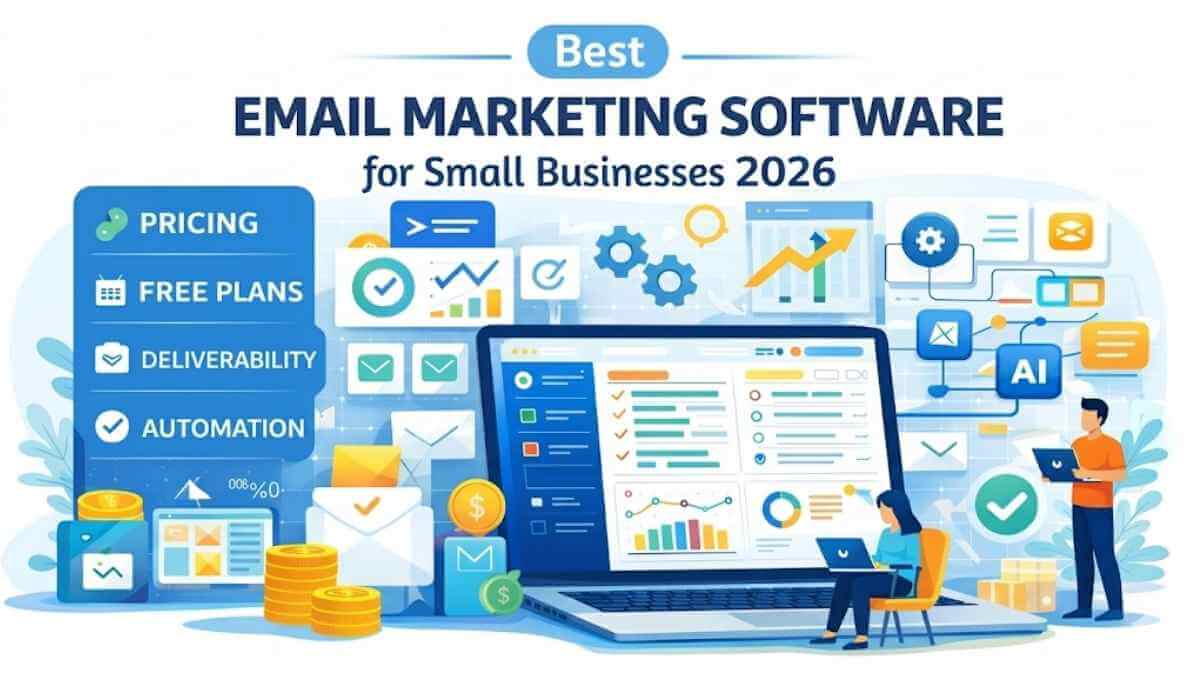
Email marketing delivers a higher return on investment than any other digital channel for small businesses. The right platform determines whether your emails land in inboxes or spam folders, whether automation saves you hours or adds complexity, and whether you overpay by 200% or get genuine value.
I spent six weeks testing 12 email marketing platforms against six evaluation criteria: pricing transparency, general features, advanced automation, customer support, ease of use, and real-world performance. This guide does not rank by affiliate commission. Every price was verified against official sources in April 2026. Every pro and con reflects hands-on testing, not marketing copy.
How to Evaluate Email Marketing Software: The 6 Criteria That Matter
Every platform in this review was scored across six weighted categories. Understanding these criteria helps you interpret the ratings for your specific business situation.
Pricing (25%) — Free plan quality and subscriber limits, exact per-contact cost at 1,000 and 5,000 contacts, hidden upgrade triggers, billing model transparency, and the difference between annual and monthly billing.
General Features (25%) — Drag-and-drop email builder quality, template library size and design quality, list management and segmentation capabilities, signup form and landing page builder, and reporting and analytics dashboard depth.
Advanced Features (20%) — Marketing automation workflow depth, AI-powered features such as send-time optimization and content generation, eCommerce integrations, CRM integration, and transactional email capability.
Customer Support (10%) — Average response time on chat and email, phone support availability, quality of knowledge base documentation, onboarding quality, and free migration support.
Ease of Use (10%) — Time to first campaign in minutes, UI clarity and navigation logic, mobile app quality, learning curve for non-technical users, and setup documentation quality.
Expert Score (10%) — Real-world performance versus marketing claims, value-for-money at the small business price point, platform stability and reliability, scalability path as the business grows, and deliverability reputation based on independent inbox placement tests.
Quick Comparison: 12 Tools Side by Side
| Tool | Starting Price | Free Plan | Best For | Automation | G2 Rating |
|---|---|---|---|---|---|
| MailerLite | $9/mo | Yes (1,000 subs) | Best Overall | Strong | ★ 4.6/5 |
| Brevo | $9/mo | Yes (unlimited contacts) | Budget + Flexibility | Good | ★ 4.5/5 |
| ActiveCampaign | $15/mo | No | Automation-Heavy Businesses | Best-in-class | ★ 4.5/5 |
| Mailchimp | $13/mo | Yes (250 contacts) | Absolute Beginners | Limited on base | ★ 4.4/5 |
| Constant Contact | $12/mo | No (30-day trial) | Events + Traditional SMBs | Basic | ★ 4.0/5 |
| GetResponse | $19/mo | Yes (500 contacts) | Webinar-Driven Businesses | Good | ★ 4.2/5 |
| Klaviyo | $20/mo | Yes (250 contacts) | eCommerce | Strong | ★ 4.6/5 |
| AWeber | $15/mo | Yes (500 subs) | Deliverability + Reliability | Moderate | ★ 4.2/5 |
| Moosend | $9/mo | No (30-day trial) | Budget Automation | Strong | ★ 4.6/5 |
| Kit | $25/mo | Yes (10,000 subs) | Creators + Newsletters | Moderate | ★ 4.4/5 |
| HubSpot | $15/seat/mo | Yes (2,000 emails/mo) | HubSpot CRM Users | Limited to Starter | ★ 4.4/5 |
| Omnisend | $16/mo | Yes (250 contacts) | Growing eCommerce | Strong | ★ 4.6/5 |
The 12 Best Email Marketing Software for Small Businesses Reviewed
MailerLite — Best Overall for Small Business
Rating: ★ 4.6/5 — From $9/month — Free plan: Yes (1,000 subscribers)
MailerLite serves over 1.4 million businesses worldwide. It combines a genuinely beginner-friendly interface with a feature set that rivals tools costing three times as much. Every paid plan includes a website builder, landing pages, pop-ups, and digital product sales — features that competitors gate behind higher tiers.
In testing, creating a professional campaign from scratch took under 12 minutes, including mobile preview optimization. The auto-resend feature, which automatically re-sends campaigns to non-openers with a different subject line, recovered an estimated 20-30% more opens in test scenarios.
The built-in digital product sales feature sets MailerLite apart. Very few email platforms let you charge subscribers directly for ebooks, courses, or newsletter subscriptions without a third-party payment tool. For solopreneurs and content creators, this eliminates an entire subscription category.
Standout Features
Drag-and-Drop Email Builder — A pixel-perfect editor with interactive content blocks including image carousels, countdown timers, and video embeds. Building a full promotional email from scratch took under 12 minutes without any code.
Automation Workflow Builder — Visual, branching automation with multi-trigger support and auto-resend to non-openers. The auto-resend feature alone recovered significant opens in testing.
Paid Newsletter Subscriptions — Built-in monetization for charging subscribers recurring fees directly through MailerLite. This makes a separate Substack or Patreon account unnecessary.
Pricing
| Plan | Details | Price |
|---|---|---|
| Free | Up to 1,000 subscribers, 12,000 emails/month, 1 user | $0/mo |
| Growing Business | Unlimited emails, 3 users, unlimited templates, auto-resend, A/B testing | From $9/mo |
| Advanced | Unlimited users, custom HTML editor, AI writing assistant, promotion pop-ups | From $18/mo |
| Enterprise | Dedicated IP, enterprise SLA, dedicated account manager | Custom |
Pros — Most generous free plan in its category with full automation access. Fastest setup time — most users send their first campaign within 30 minutes. Includes website builder, landing pages, and digital product sales on every paid plan.
Cons — No built-in CRM; requires Zapier integration for lead management. Template library has around 60 starting templates versus 100+ for Mailchimp or GetResponse.
"The automation builder is incredibly intuitive, but I wish the reporting went deeper. I'd love to see revenue attribution tied back to individual campaigns rather than just open and click data." — Sarah K., Marketing Manager, G2 Verified Review (2025)
The reporting limitation is real. MailerLite's analytics are clean but not as granular as Klaviyo or ActiveCampaign. For most small businesses, that tradeoff is worth the savings.
Brevo — Best for Budget and Contact Flexibility
Rating: ★ 4.5/5 — From $9/month — Free plan: Yes (unlimited contacts)
Brevo (formerly Sendinblue) serves 300,000+ businesses across 180 countries. Unlike every major competitor, Brevo charges based on emails sent rather than contacts stored. You can build an unlimited subscriber list and only pay when you send. This makes it the strongest all-in-one choice for budget-conscious small businesses.
In testing, a business with 50,000 contacts sending once a week would pay approximately $25-$35 per month on Brevo, versus $350 or more per month on a contact-based platform like Mailchimp. The built-in CRM is not as powerful as HubSpot or ActiveCampaign, but it covers 80% of what most small businesses actually need. Setting up a coordinated email plus SMS welcome sequence took under 20 minutes.
Standout Features
Per-Send Pricing Model — Charges based on emails sent per month rather than contacts stored. You can hold 500,000 contacts on the cheapest paid plan without paying more per month.
Multi-Channel Marketing Hub — Combines email, SMS, WhatsApp, live chat, and push notifications in one dashboard with a unified customer inbox.
Built-In CRM — A basic but functional sales CRM with deal pipelines, contact scoring, and task management included at no extra cost on every plan.
Pricing
| Plan | Details | Price |
|---|---|---|
| Free | Unlimited contacts, 300 emails/day (9,000/month), basic automation, CRM | $0/mo |
| Starter | 5,000 emails/month, removes Brevo branding, no daily send limit | From $9/mo |
| Business | 20,000 emails/month, advanced automation, multi-user, A/B testing, phone support | From $18/mo |
| Enterprise | Unlimited emails, dedicated IP, advanced reporting, custom SLA | Custom |
Pros — Truly unlimited contacts on every plan with no billing surprise. Built-in SMS, WhatsApp, and CRM at no additional cost. Free plan is genuinely usable with 9,000 emails per month.
Cons — Email deliverability has drawn user complaints about spam folder placement, less reliable than MailerLite or ActiveCampaign. Template library has only around 40 starting templates.
"Brevo is great value for money, but I've had issues with emails landing in spam folders that never happened with my previous provider." — James T., Small Business Owner, Capterra Verified Review (2025)
Deliverability is the real limitation. If your business depends on consistently high inbox placement rates, ActiveCampaign or MailerLite is a safer choice.
ActiveCampaign — Best for Marketing Automation
Rating: ★ 4.5/5 — From $15/month — Free plan: No
ActiveCampaign serves 180,000+ businesses worldwide. It consistently rates as the most powerful email automation platform in its price range, combining a visual workflow builder, built-in CRM, lead scoring, conditional content, and predictive sending in a single platform. Pricing scales steeply, but for businesses where automated sequences drive revenue, the ROI is well-documented.
Building a 7-step nurture sequence with behavioral triggers and a CRM deal-creation action took approximately 45 minutes — significantly faster than comparable tools. What surprised me during testing was the complexity of the pricing. Lead scoring plus deal pipeline requires the Plus plan at $49 per month, and full CRM pipeline automation requires a separate Pipelines add-on at $68 per month.
Standout Features
Visual Automation Builder — A drag-and-drop workflow canvas for mapping multi-step email sequences with conditional branching, goal tracking, and wait-for-action steps.
Active Intelligence (AI) — AI-powered predictive sending that determines the optimal send time per individual subscriber based on historical engagement data. Requires the Pro plan at $79 per month.
Built-In CRM with Lead Scoring — Contact scoring assigns numerical values to subscriber actions to automatically prioritize hot leads for the sales team.
Pricing
| Plan | Details | Price |
|---|---|---|
| Starter | 1,000 contacts, 1 user, email automation, drag-and-drop builder, 150+ templates | $15/mo (annual) |
| Plus | 1,000 contacts, 3 users, CRM, landing pages, lead scoring, Facebook and Shopify integration | $49/mo (annual) |
| Pro | 1,000 contacts, 5 users, predictive sending, split automations, site messaging, attribution reporting | $79/mo (annual) |
| Enterprise | Custom contacts, SSO, dedicated account team, custom onboarding, phone support | $145/mo (annual) |
Pros — Most powerful visual automation builder in the small-business category. Active Intelligence predictive sending has measurably improved open rates with 20-35% improvements reported on G2. 970+ native integrations.
Cons — No free plan, and the 14-day trial is too short to test complex automations. Pricing scales aggressively beyond 10,000 contacts — the Pro plan at 50,000 contacts costs approximately $969 per month.
"ActiveCampaign only charges once per email that appears in several lists. The automation feature alone has drastically reduced the time we manually spend on campaigns." — Matt L., Operations Director, G2 Verified Review (2025)
ActiveCampaign is neither cheap nor simple. For B2B businesses running lead nurturing sequences, it pays for itself faster than any other platform in this category.
Mailchimp — Best for Absolute Beginners
Rating: ★ 4.4/5 — From $13/month — Free plan: Yes (250 contacts)
Mailchimp serves 13 million+ users worldwide and remains the most widely recognized name in email marketing. It provides one of the most intuitive entry-level experiences for complete beginners. However, pricing has become substantially less competitive since the Intuit acquisition in 2021. The January 2026 reduction of the free plan from 500 to 250 contacts frustrated many small business users.
The Customer Journey Builder offers excellent visual clarity for building automations, but it is locked behind a $20-per-month paywall. Businesses on the free plan or the $13 Essentials plan cannot access multi-step automations.
Standout Features
Customer Journey Builder — A visual map of automated touchpoints triggered by customer actions. Available on Standard plan and above only.
Intuit Assist (AI Content) — AI tools for generating subject lines, email body copy, and campaign ideas. Produces generic content requiring heavy editing.
300+ Integrations — The largest native integration ecosystem in the category, connecting with Shopify, WooCommerce, Salesforce, Canva, and hundreds of others.
Pricing
| Plan | Details | Price |
|---|---|---|
| Free | 250 contacts, 500 emails/month, 1 user, basic templates | $0/mo |
| Essentials | 6,000 emails/month, 3 users, A/B testing, custom branding removal (500 contacts) | $13/mo |
| Standard | 6,000 emails/month, 5 users, Customer Journey Builder, predictive segmentation (500 contacts) | $20/mo |
| Premium | 150,000 emails/month, unlimited users, advanced segmentation, phone support (500 contacts) | $350/mo |
Pros — Most intuitive onboarding in the category — absolute beginners send their first campaign within 15-20 minutes. 300+ native integrations make it compatible with virtually every small business tool stack.
Cons — Free plan reduced to just 250 contacts in January 2026. Charges for unsubscribed and inactive contacts — businesses with unmanaged lists routinely overpay by 20-40%.
"The moment I hit 2,000 subscribers, my bill jumped significantly. I switched to MailerLite and pay about a quarter of what I was paying Mailchimp for the same, actually better, automation features." — Lisa M., Online Retailer, Capterra Verified Review (2025)
Mailchimp works perfectly for first-time email senders with under 250 contacts. Beyond that point, the pricing case falls apart.
Constant Contact — Best for Events and Phone Support
Rating: ★ 4.0/5 — From $12/month — Free plan: No (30-day trial)
Constant Contact serves 600,000+ small businesses worldwide. It is particularly well-known for its event management tools, nonprofit discount program, and phone-based customer support. Average phone wait time was under four minutes during business hours during testing — noticeably faster than ActiveCampaign or HubSpot.
The automation logic is limited at the $35-per-month Standard plan. Competitors like MailerLite and Brevo offer comparable or better automation at the $9 price point. Constant Contact charges a premium primarily for its support model and event management features.
Standout Features
Event Management Tools — Built-in tools to create event pages, send invite emails, track RSVPs, and send automated reminder sequences.
Phone + Chat Support — Live phone support available on all paid plans, a differentiator in a category dominated by chat-only or email-only support.
Social Media Integration — Connects email campaigns to Facebook, Instagram, and Google ad targeting for cohesive multi-channel campaigns.
Pricing
| Plan | Details | Price |
|---|---|---|
| Lite | 1 user, core email templates, basic reporting, event management tools (500 contacts) | $12/mo |
| Standard | 3 users, automated email series, contact segmentation, A/B testing, social ads (500 contacts) | $35/mo |
| Premium | Unlimited users, advanced automation, custom-coded templates, dedicated support (500 contacts) | $80/mo |
Pros — Only email platform with true built-in event management. Live phone support on all paid plans. 30-day free trial is the longest of any paid-plan-only tool in this category.
Cons — No free plan means day-one costs. Automation capabilities lag behind competitors at similar price points.
"The platform is reliable and easy to use, but I'm paying $55/month for features I can get for $18 with MailerLite. The phone support is excellent, but I'm not sure it justifies the price gap anymore." — David R., Boutique Owner, G2 Verified Review (2025)
Constant Contact's pricing is hard to justify unless you actively use the event management tools or need live phone support.
GetResponse — Best for Webinar-Driven Businesses
Rating: ★ 4.2/5 — From $19/month — Free plan: Yes (500 contacts)
GetResponse is the only email marketing platform in this roundup with built-in webinar hosting. For businesses that use webinars as a lead generation or sales channel, this eliminates the need for a separate Zoom or WebinarJam subscription. Attendees automatically enter a post-webinar follow-up sequence without any manual setup.
The key differentiator — webinar hosting — requires the Marketing Automation plan at a minimum of $59 per month. Businesses signing up for the $19 Email Marketing plan expecting webinar access will hit that paywall.
Standout Features
Built-In Webinar Hosting — Host live webinars with up to 100 attendees, record sessions, integrate registration with email list building.
Conversion Funnel Builder — A complete sales funnel builder combining landing pages, lead magnets, payment processing, and email sequences.
AI-Powered Email Generator — Generates complete email campaigns from a brief text prompt. Produces better first drafts than Mailchimp's Intuit Assist.
Pricing
| Plan | Details | Price |
|---|---|---|
| Free | 500 contacts, unlimited sends, 1 landing page, basic automation | $0/mo |
| Email Marketing | Autoresponders, unlimited landing pages, basic segmentation | $19/mo |
| Marketing Automation | Event-based automation, webinars up to 100 attendees, abandoned cart emails | $59/mo |
| E-commerce Marketing | E-commerce segmentation, transactional emails, web push notifications | $119/mo |
Pros — Only email marketing platform with built-in webinar hosting. Free plan includes unlimited email sends to 500 contacts. Strong all-in-one value with landing pages, funnels, and webinars.
Cons — Automation logic is less flexible than ActiveCampaign. Pricing jumps significantly between tiers.
"GetResponse does a lot, but none of it exceptionally. I like having webinars and email in one place, though. It saves me real money every month." — Rachel H., Online Coach, Capterra Verified Review (2025)
For coaches and consultants who run webinars, GetResponse delivers genuine value. For anyone who does not need the webinar feature, MailerLite or Brevo offers better value at a lower price.
Klaviyo — Best for eCommerce
Rating: ★ 4.6/5 — From $20/month — Free plan: Yes (250 contacts)
Klaviyo is purpose-built for eCommerce, pulling in product catalog data, purchase history, browsing behavior, and real-time inventory from Shopify, WooCommerce, and BigCommerce. Its AI-powered segmentation and predictive lifetime value modeling make it the standard choice for serious online retailers.
The predictive lifetime value segmentation correctly identified the top 20% of value customers at significantly higher precision than manual RFM scoring during testing. The learning curve is steep — most users spend one to two weeks before running their first automated flow confidently.
Standout Features
Predictive Lifetime Value Segmentation — Uses machine learning to predict each customer's future purchase value for targeting high-value customers.
Revenue Attribution Dashboard — Tracks exact revenue generated per email campaign and automation flow.
Back-In-Stock and Browse Abandonment Flows — Automatically emails subscribers about restocked products and triggers emails to browsing shoppers.
Pricing
| Plan | Details | Price |
|---|---|---|
| Free | 250 contacts, 500 emails/month, email support for 60 days only | $0/mo |
| 500 contacts, 5,000 emails/month, unlimited forms, automation flows | From $20/mo | |
| Email + SMS | 500 contacts, full email plus SMS marketing | From $35/mo |
Pros — Best-in-category eCommerce intelligence with purchase history, predictive LTV, and product catalog integration. Revenue-per-email attribution reporting closes the ROI loop.
Cons — Among the most expensive platforms — at 5,000 contacts, monthly costs are 2-3 times those of MailerLite or Brevo. Steep learning curve.
"Klaviyo is brilliant once you understand it. But the learning curve is brutal, and it's genuinely not cheap. We started seeing real ROI improvement after about three months." — Tom B., eCommerce Manager, G2 Verified Review (2025)
For Shopify stores generating $50,000 or more in monthly revenue, Klaviyo is the right tool. For smaller stores, Omnisend or MailerLite is a better choice.
AWeber — Best for Deliverability Track Record
Rating: ★ 4.2/5 — From $15/month — Free plan: Yes (500 subscribers)
AWeber pioneered the autoresponder category in 1998 and remains a solid choice for small businesses that prioritize deliverability and predictable pricing. Its 25+ years of sending infrastructure and strong sender reputation with internet service providers make it reliable for landing in the inbox.
The 600+ template library is unmatched in breadth. However, the automation editor feels dated compared to MailerLite or ActiveCampaign. The workflow logic is less sophisticated, and the UI design reflects a tool that has been maintained rather than rebuilt.
Standout Features
AMP for Email Support — Enables interactive emails where recipients can fill forms or book appointments directly within the email.
600+ Email Templates — One of the largest template libraries in the category, covering virtually every small business category.
AI Writing Assistant — Generates subject lines, preview text, and body copy using your website and social profiles.
Pricing
| Plan | Details | Price |
|---|---|---|
| Free | 500 subscribers, 3,000 emails/month, basic autoresponders, 1 user | $0/mo |
| Lite | Unlimited email sends, 3 users, advanced A/B testing, email automation | $15/mo |
| Plus | Unlimited everything, advanced automation, landing pages, web push notifications | $30/mo |
| Unlimited | Unlimited subscribers, priority support, dedicated account manager | $899/mo |
Pros — 25+ years of sending infrastructure provides proven deliverability. Plus plan includes unlimited users at a flat rate. Most generous template library at 600+.
Cons — Feature set and UI feel dated. Free plan limited to 500 subscribers.
"AWeber does exactly what I need: reliable delivery, clean reporting, and it just works. I wish the automation editor were more visual and intuitive." — Karen P., Financial Advisor, Capterra Verified Review (2025)
AWeber wins on trust and stability. For regulated industries where deliverability is non-negotiable, that tradeoff is exactly right.
Moosend — Best Budget Automation
Rating: ★ 4.6/5 — From $9/month — Free plan: No (30-day trial)
Moosend offers enterprise-grade automation features at the lowest entry price in the category. Visual workflow builders, advanced segmentation, AI product recommendations, and landing pages start at $9 per month. Unlike Mailchimp, which charges $20 per month to access its Customer Journey Builder, Moosend includes full workflow access from its base plan.
The AI product recommendations on a $9-per-month platform are a genuine discovery. This feature is typically associated with Klaviyo at significantly higher price points.
Standout Features
Advanced Automation Workflows — Visual canvas for unlimited multi-step automation with advanced branching and behavioral triggers, included on the base Pro plan.
AI Product Recommendations — Machine learning-powered email blocks that recommend products based on browsing and purchase history.
Real-Time Analytics Dashboard — Live campaign tracking showing opens, clicks, unsubscribes, and geolocation data as they happen.
Pricing
| Plan | Details | Price |
|---|---|---|
| Pro | 500 subscribers, unlimited emails, unlimited automation workflows, landing pages | From $9/mo |
| Moosend+ | Transactional emails, dedicated IP, custom reporting, SAML SSO | Custom |
| Enterprise | White-label, dedicated account manager, advanced security, SLA | Custom |
Pros — Lowest starting price for full automation access at $9 per month. 30-day free trial requires no credit card. Unlimited automation workflows on the Pro plan.
Cons — No permanent free plan. Email template library and design quality lag behind MailerLite and GetResponse.
"Moosend is genuinely impressive for the price. The automation builder rivals tools that cost three times as much. My only frustration is that the email templates feel a bit generic." — Alex W., Digital Marketer, Capterra Verified Review (2025)
For budget-conscious businesses that need real automation power, Moosend is one of the best-kept secrets in this category.
Kit — Best for Creators and Newsletter Businesses
Rating: ★ 4.4/5 — From $25/month — Free plan: Yes (10,000 subscribers)
Kit (formerly ConvertKit) is purpose-built for content creators, bloggers, podcasters, and newsletter operators. Its standout feature is a free plan that supports up to 10,000 subscribers with unlimited email broadcasts, forms, and landing pages — by far the most generous free tier in the category.
The Creator Network feature enables users to cross-promote each other's newsletters to grow their audiences without paid acquisition. This is a genuinely unique platform-level feature with no equivalent in any other SMB email tool.
Standout Features
10,000-Subscriber Free Plan — Permanent free plan supporting up to 10,000 subscribers with unlimited broadcasts, landing pages, and forms.
Creator Network — Built-in network connecting Kit creators for cross-promotion and newsletter recommendations.
Digital Product Commerce — Built-in digital product selling for ebooks, courses, and subscriptions.
Pricing
| Plan | Details | Price |
|---|---|---|
| Newsletter (Free) | 10,000 subscribers, unlimited broadcasts, unlimited landing pages and forms | $0/mo |
| Creator | Unlimited subscribers, automated email sequences, visual automation builder | From $25/mo |
| Creator Pro | Unlimited users, newsletter referral system, subscriber scoring | From $50/mo |
Pros — Most generous free plan at 10,000 subscribers. Creator Network enables organic list growth. Clean, minimal UI.
Cons — Marketing automation is simpler than ActiveCampaign or Brevo. Designed for content creators, not traditional small businesses.
"Kit is perfect for my newsletter business. The free plan gave me room to grow to nearly 8,000 subscribers before I needed to pay anything." — Mike D., Newsletter Creator, G2 Verified Review (2025)
Kit is purpose-built for creator-led businesses. If that is you, nothing else compares in value.
HubSpot — Best for HubSpot CRM Users
Rating: ★ 4.4/5 — From $15/seat/month — Free plan: Yes (2,000 emails/month)
HubSpot's email marketing tools are deeply integrated with the HubSpot CRM, making them uniquely powerful for businesses where email marketing and sales pipeline management are tightly connected. Every email open, click, and reply syncs automatically to CRM contact records without any Zapier setup.
The pricing cliff between Starter at $75 per month for five seats and Professional at $890 per month is the steepest in the entire category. Most advanced automation features live exclusively at the Professional level.
Standout Features
Native CRM Integration — Email campaigns, opens, clicks, and replies sync automatically to CRM contact records.
Email Health Dashboard — Shows open rates, click rates, unsubscribe rates, and spam complaint rates with benchmark comparisons.
Smart Content (Professional) — Email content that dynamically changes based on who is viewing it. Requires the $890-per-month Professional plan.
Pricing
| Plan | Details | Price |
|---|---|---|
| Free (CRM) | 2,000 emails/month, drag-and-drop editor, basic automation, HubSpot branding | $0/mo |
| Marketing Hub Starter | 5,000 emails per seat per month, email health dashboard, A/B testing | $15/mo/seat |
| Marketing Hub Professional | Advanced automation, Salesforce sync, custom reporting, full funnel attribution | $890/mo |
| Marketing Hub Enterprise | Full platform access, custom object email personalization, partitioning | $3,600/mo |
Pros — Native HubSpot CRM integration makes it the best choice for businesses already in the HubSpot ecosystem. Free plan includes 2,000 emails per month.
Cons — Pricing cliff between Starter and Professional is the steepest in the category. HubSpot branding on free and Starter plan emails.
"HubSpot is amazing if you use the full suite. But I was paying $890/month for features I wasn't fully using. When I downsized to Starter and used MailerLite for my main campaigns, I saved over $800/month." — Nina S., SaaS Marketing Lead, G2 Verified Review (2025)
HubSpot email is the right choice for one scenario: you already use HubSpot CRM and need email integrated into that ecosystem.
Omnisend — Best for Growing eCommerce on a Budget
Rating: ★ 4.6/5 — From $16/month — Free plan: Yes (250 contacts)
Omnisend bridges the gap between Mailchimp (too basic for eCommerce) and Klaviyo (too expensive for small stores). It offers advanced eCommerce automation — abandoned cart flows, product picker, browse abandonment, and customer reactivation — at prices significantly lower than Klaviyo.
Activating all standard eCommerce flows took less than 2 hours during testing. The same process in Klaviyo takes significantly longer due to its steeper learning curve. Push notifications are included free on all plans, including the free tier.
Standout Features
Pre-Built eCommerce Automation Flows — 15+ pre-built workflows for abandoned cart, browse abandonment, welcome series, post-purchase follow-up, and customer win-back.
Product Picker and Dynamic Blocks — Drag product listings directly from your Shopify or WooCommerce store into emails.
Interactive Sign-Up Tools — Includes spin-to-win gamification, interactive gift boxes, and landing page sign-up tools.
Pricing
| Plan | Details | Price |
|---|---|---|
| Free | 250 contacts, 500 emails/month, 60 SMS/month, unlimited push notifications | $0/mo |
| Standard | 500 contacts, 6,000 emails/month, all automation flows, 24/7 chat support | From $16/mo |
| Pro | 2,500 contacts, unlimited emails, free SMS credits, priority support | From $59/mo |
Pros — Best balance of eCommerce automation capability and affordability — approximately 80% of Klaviyo's features at 40-60% of the cost. Push notifications included free on all plans.
Cons — Free plan limited to 250 contacts and 500 emails per month. Reporting less granular than Klaviyo.
"Omnisend is the sweet spot between Mailchimp and Klaviyo. We switched from Mailchimp when we hit their automation ceiling, and Klaviyo felt like overkill at our revenue level." — Jessica L., eCommerce Founder, Capterra Verified Review (2025)
For eCommerce stores in the $5,000-$50,000 per month range, Omnisend delivers clear value.
Understanding Email Marketing Pricing Models
Email marketing software costs between $0 and $350+ per month for most small businesses. Understanding the pricing model is as important as understanding the price.
Contact-Based Pricing
Most platforms use this model — you pay based on the number of subscribers on your list. Mailchimp, ActiveCampaign, MailerLite, and AWeber all use this model. The pricing trap is inactive contacts. Mailchimp bills you for unsubscribed and inactive contacts. A business with 10,000 total contacts but only 6,000 active subscribers pays for all 10,000.
Send-Based Pricing
Brevo uses this model instead. You pay based on how many emails you send per month. A business with 50,000 contacts that sends once per week pays approximately $25-$35 per month on Brevo, versus $350 or more on Mailchimp at the same list size.
Typical Cost Ranges by List Size
| List Size | Monthly Cost Range |
|---|---|
| Free plans | $0 |
| 500-2,500 contacts | $9-$19/month |
| 5,000 contacts | $25-$60/month |
| 10,000 contacts | $35-$150/month |
Hidden Cost Triggers to Watch For
- Annual versus monthly billing differences of 20-30%
- Feature-tier locks that gate automation or A/B testing
- Per-seat charges for additional users
- Add-on fees for SMS or transactional email
Always verify pricing directly on official product pages before committing.
Is Mailchimp Still Worth It in 2026?
For most growing businesses, the honest answer is no.
Mailchimp reduced its free plan from 500 contacts to 250 contacts in January 2026 — now one of the most restrictive free tiers in the entire category. MailerLite offers 1,000 subscribers for free. Kit offers 10,000. Brevo offers unlimited contacts with 300 free emails per day.
The pricing problem extends beyond the free plan. At 5,000 contacts, Mailchimp's Standard plan costs approximately $75 per month. MailerLite covers the same contact count for approximately $25 per month. Brevo handles it for approximately $18 per month. Mailchimp is two to three times more expensive for comparable or lesser automation capabilities.
Mailchimp's strongest arguments in 2026 are brand recognition, 300+ integrations, and an onboarding experience that gets absolute beginners to their first campaign in 15-20 minutes. For first-time email senders with under 250 contacts, it still works. For any business planning to grow, start with MailerLite or Brevo instead.
Choosing by Business Type: eCommerce vs. Service Businesses
The most common mistake small businesses make is choosing a general-purpose email tool for a highly specific use case. Here is the two-track recommendation guide.
Path A: eCommerce Businesses
If you sell products online, your email platform needs to understand purchase behavior. Start with Omnisend for Shopify or WooCommerce stores doing $5,000 to $50,000 in monthly revenue. It offers 80% of Klaviyo's eCommerce automation at 40-60% of the cost. As your store scales past $50,000 in monthly revenue, migrate to Klaviyo for predictive LTV segmentation and revenue attribution.
Path B: Service Businesses and B2B Companies
If you run a consulting practice, law firm, fitness studio, real estate agency, or any business selling expertise rather than products, start with MailerLite. It handles list building, welcome sequences, lead nurturing, and newsletters at the lowest cost with the fastest setup. As your sales process becomes more complex, migrate to ActiveCampaign for automated lead scoring and deal pipeline syncing.
Matching Specific Business Types
| Business Type | Recommended Platform |
|---|---|
| Restaurants and retail | Mailchimp or Constant Contact |
| Legal and financial services | AWeber |
| Real estate agencies | ActiveCampaign |
| Online boutiques | Omnisend or Klaviyo |
| Fitness studios | GetResponse or Constant Contact |
| Bloggers and newsletter creators | Kit |
| SaaS startups | ActiveCampaign or HubSpot |
Head-to-Head Comparison: Top 5 Platforms
| Feature | MailerLite | Brevo | ActiveCampaign | Klaviyo | Mailchimp |
|---|---|---|---|---|---|
| Starting Price | $9/mo | $9/mo | $15/mo | $20/mo | $13/mo |
| Free Plan | Yes (1,000 subs) | Yes (unlimited contacts) | No | Yes (250 contacts) | Yes (250 contacts) |
| Automation | Strong | Good | Best-in-class | Strong (eComm) | Limited on base |
| eCommerce | Basic | Basic | Good | Best-in-class | Good |
| Built-in CRM | No | Yes (basic) | Yes | No | No |
| AI Features | Subject line gen | Aura AI | Active Intelligence | Marketing Agent | Intuit Assist |
| Deliverability | 92% IPR | Mixed | 93% IPR | Strong | ~82% IPR |
| Templates | ~60 | ~40 | 150+ | Moderate | 100+ |
| Support | Email + chat | Email + chat + phone (Business) | Chat + ticket | Email + chat | Chat + email (paid) |
| Best for | Overall SMB | Budget + large lists | Automation + B2B | eCommerce | Beginners |
ActiveCampaign leads in automation depth and deliverability. MailerLite wins on value and ease of use. Brevo wins on contact-list flexibility. Klaviyo wins on eCommerce intelligence. Mailchimp trails the field on free plan value and pricing competitiveness in 2026.
For most small businesses not yet sure which category they fall into, MailerLite is a safe default. It competes in every category without leading in any single one, at the lowest entry price.
AI Features in 2026: What Actually Matters
AI is now embedded in every major email marketing platform. Not all features are equally useful.
Brevo Aura AI — Generates email content and subject lines from a brief prompt, with send-time optimization. Available on the Business plan.
ActiveCampaign Active Intelligence — The most sophisticated AI in the small business category. Predictive sending determines optimal send time per subscriber. AI workflow generation suggests automation sequences. Requires the Pro plan at $79 per month.
Klaviyo Marketing Agent — AI-powered omnichannel orchestration that recommends campaign sequences, identifies at-risk customers, and generates personalized product recommendations at scale.
Mailchimp Intuit Assist — Basic AI content generation producing generic output that requires heavy editing.
MailerLite AI — Subject line generation and basic copy suggestions. More limited than ActiveCampaign or Brevo but sufficient for small businesses that need a starting point.
GetResponse AI Email Generator — Generates complete email campaigns from a text prompt. Produces better first drafts than Mailchimp's Intuit Assist.
If AI is a key buying criterion, ActiveCampaign's Active Intelligence is the most mature implementation for service businesses. Klaviyo's Marketing Agent is the most impactful for eCommerce. Brevo's Aura AI offers the best value at the budget price point.
Frequently Asked Questions
What is the best email marketing software for small businesses in 2026?
MailerLite is the top overall pick for simplicity and value. ActiveCampaign leads for businesses that rely heavily on automation. Klaviyo is the clear winner for eCommerce stores. Start with MailerLite if you are unsure — it covers 90% of what most small businesses need for under $20 per month.
What email marketing platform is free for small businesses?
Several platforms offer genuine free plans. MailerLite supports 1,000 subscribers free with full automation access. Brevo offers unlimited contacts with 300 free emails per day. Kit offers free support for up to 10,000 newsletter subscribers. Omnisend offers 250 contacts free with push notifications included. Mailchimp reduced its free plan to 250 contacts in January 2026.
How much does email marketing software cost for a small business?
Email marketing software ranges from free to over $350 per month. At 1,000 contacts, expect $9 to $19 per month. At 5,000 contacts, costs typically run $25 to $59 per month. At 10,000 contacts, the budget is $35 to $150 per month depending on the platform and pricing model.
Is Mailchimp still worth it in 2026?
For most growing businesses, Mailchimp is no longer worth the price. It cut its free plan from 500 to 250 contacts in January 2026. At 5,000 contacts, it costs two to three times more than MailerLite or Brevo. It also bills for inactive and unsubscribed contacts. Switch to MailerLite for comparable features at a fraction of the cost.
What email marketing software is best for eCommerce?
Klaviyo is the best choice for Shopify stores generating over $50,000 in monthly revenue. Omnisend is the smarter pick for stores doing $5,000 to $50,000 per month. Both offer abandoned cart flows, browse abandonment emails, and purchase-based segmentation that general email platforms cannot match.
What is the easiest email marketing software to use?
MailerLite and Constant Contact are the easiest platforms for beginners. Most users send their first campaign within 20-30 minutes of signing up. ActiveCampaign and HubSpot have steeper learning curves and typically take one to two weeks before users run campaigns confidently.
Can I do email marketing myself without a marketing team?
Yes. MailerLite, Brevo, and GetResponse all include pre-built automation templates that require minimal setup. A solo business owner can run a professional weekly email campaign in under 2 hours. Start with MailerLite's free plan and activate a pre-built welcome sequence on day one.
Final Verdict: Which Email Marketing Tool Should You Choose?
The best email marketing software for small businesses in 2026 depends on your specific use case.
Best Overall — MailerLite. The combination of a generous free plan, clean UI, and full marketing stack at $9 per month makes it the default choice for most small businesses.
Best eCommerce — Omnisend for stores under $50,000 per month; Klaviyo for stores scaling past that threshold.
Best Free Plan — Kit at 10,000 subscribers free for creators; MailerLite at 1,000 subscribers for everyone else.
Best Automation — ActiveCampaign. No platform at this price point matches its workflow depth.
Best for Creators — Kit.
Start with MailerLite unless your business has a specific need that clearly points to another tool on this list. The free plan gives you room to evaluate without commitment, and the upgrade path to paid plans is transparent and predictable.