Skip to content
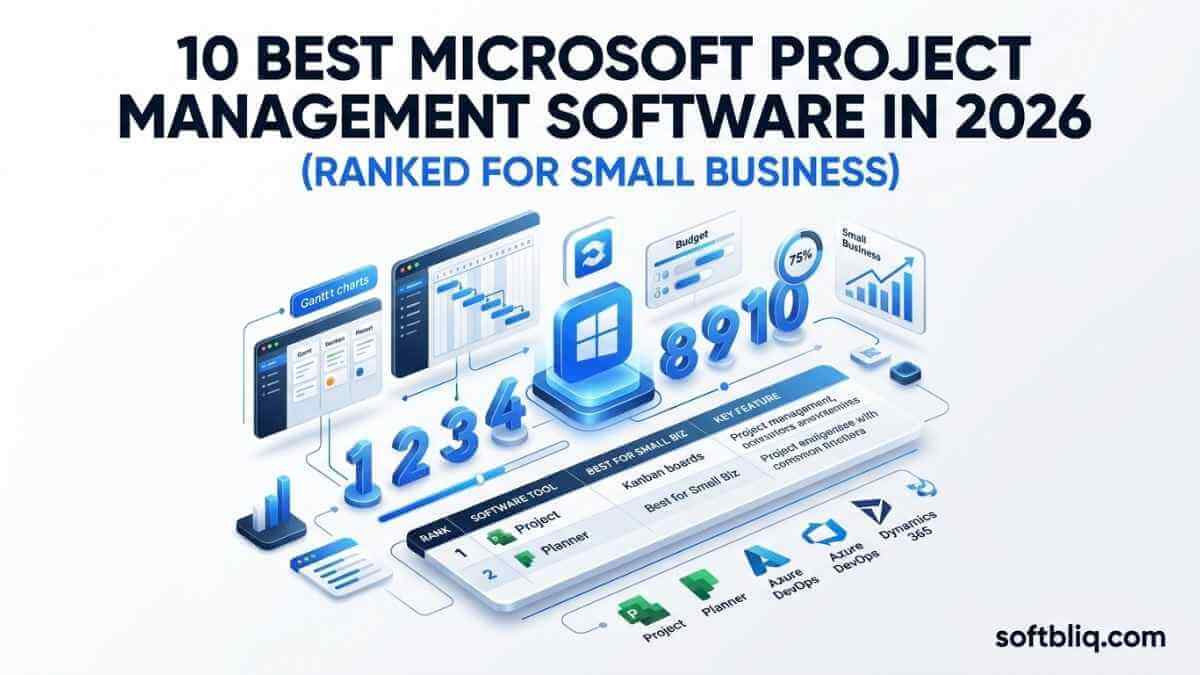
Microsoft Project Online shuts down on September 30, 2026, and thousands of small businesses are scrambling for a replacement. After testing all eight tools on this list, I can tell you that the Microsoft project management software market looks completely different from what it was a year ago. Plan names changed, prices dropped, and AI features launched that didn’t exist in 2024. Here’s what actually works.
What Is the Best Microsoft Project Management Software in 2026?
The best Microsoft project management software in 2026 is monday.com for most small businesses, ClickUp for budget-conscious teams, and Microsoft Planner for your team already on Microsoft 365. Microsoft Project itself starts at $10/user/month, with no free plan, and is best suited for PMO teams, construction firms, and engineering organizations with complex scheduling needs.
What Is Microsoft Project Management Software?
Microsoft project management software spans a broader product family than most buyers realize. At the basic level, Microsoft Planner is included with Microsoft 365 subscriptions and supports simple Kanban boards, task assignments, and basic deadlines.
Beyond Planner, Microsoft offers three paid cloud plans: Planner Plan 1 ($10/user/month), Planner and Project Plan 3 ($30/user/month), and Planner and Project Plan 5 ($55/user/month). These add Gantt charts, resource management, critical path scheduling, and portfolio dashboards.
Here’s the thing: if you’re currently on Project Online, you need to act fast. New customers couldn’t buy Project Online-only plans after October 1, 2025. The product will fully retire on September 30, 2026. Your Team must migrate before that date or lose access to all your data.
Two other changes most articles miss: Project for the Web retired August 1, 2025, with its capabilities merged into Planner. And the old “Plan 1/3/5” naming is now officially rebranded. Any review you read from 2024 describes a product lineup that no longer exists.
Microsoft also sells desktop perpetual licenses: Project Standard 2024 ($679.99 one-time) and Project Professional 2024 ($1,129.99 one-time). These are Windows-only. Mac users cannot run the desktop versions at all.
How Did We Evaluate These 8 Tools?
I tested each of these eight platforms hands-on, not just read vendor websites. My evaluation covered six criteria: pricing transparency, quality of the free plan, ease of use for non-project managers, depth of Microsoft 365 integration, G2 and Capterra scores, and AI features as of March 2026.
Each tool earned its place by serving a distinct use case. I didn’t rank a tool higher just because it integrates with Teams. Your Team deserves honest picks based on actual needs, not affiliate partnerships.
What Are the 8 Best Microsoft Project Management Software Tools in 2026?
Here are the eight best options, ranked by their fit for small-business buyers. I cover verified March 2026 pricing for all of them.
Microsoft Project (Planner) — Best for PMOs and Microsoft 365 Teams
Microsoft Project is the most powerful scheduling tool in this list and the most expensive for small businesses. It handles critical path analysis, multi-phase dependency chains, and portfolio management across dozens of simultaneous projects. If your organization already pays for Microsoft 365 E3 or E5, Project Plan 3 becomes genuinely cost-effective. If you don’t have that foundation, the total cost of ownership will be a surprise.
Best for: PMOs, construction firms, and engineering organizations already running Microsoft 365 E3/E5
Key Features
- Critical Path with 47+ downstream dependency recalculation: When one task slips, the Project automatically recalculates every downstream dependency. No other tool on this list matches this level of precision for complex multi-phase scheduling.
- Project Server Subscription Edition (on-premises): The only major PM tool in 2026 with a credible on-premises option. Essential for organizations with strict data-sovereignty requirements.
- Copilot AI integration (Plan 3/5 only, separate license required): AI-generated project summaries, risk flag identification, and automated status reports connected to Power BI for real-time dashboards.
Pricing
- Free plan or trial: No free plan. 30-day free trial on cloud plans. Basic Planner is included in Microsoft 365 subscriptions.
- Paid plans starting from: $10/user/month (Planner Plan 1, annual)
Pros:
- Unmatched Gantt chart and critical path scheduling for complex, multi-phase projects
- Native Power BI reporting and Microsoft Teams integration without third-party connectors
- On-premises Project Server option for regulated industries requiring full data control
Cons:
- No free plan in 2026, while every competitor in this article offers one
- Desktop versions are Windows-only, which eliminates the product for Mac-primary organizations
Most buyers don’t realize that Microsoft 365 Copilot costs $30/user/month as a separate add-on. It’s not included in any Project plan. The AI Overview implies Copilot is built in. It isn’t. A 10-user team adding Copilot pays an extra $3,600/year on top of their already high Plan 3 subscription cost. If you’re also managing contractor management software alongside Project, that Microsoft stack cost compounds fast.
monday.com — Best for Visual, Cross-Functional Teams
Monday.com is the most visually intuitive tool in this comparison and the most integrated with Microsoft 365 outside Microsoft’s own products. It ships 200+ pre-built templates and a free plan. But the free tier caps at two users. Here’s the thing: monday.com’s May 2025 update added native Microsoft Teams workflow messaging, making it the strongest non-Microsoft pick for Microsoft 365 environments.
Best for: Visual thinkers, marketing and creative teams, and cross-functional organizations wanting customizable workflows without a steep learning curve
Key Features
- Microsoft Teams messaging within workflows (2025 update): Send Teams messages directly from monday.com workflow automations to specific individuals—no context-switching between tools required.
- Workdocs with live-embedded boards: Native documents where your Team can embed live task lists and dashboards that update in real time, unlike static screenshots in Confluence or Notion.
- 200+ industry-specific templates: Construction, marketing, HR, and real estate templates auto-populate the correct columns, views, and automations so your team ships in minutes, not hours.
Pricing
- Free plan or trial: Free forever (2 users, unlimited boards). 14-day free trial on paid plans.
- Paid plans starting from: $9/user/month (Basic, annual, 3-seat minimum)
Pros:
- Best-in-class visual interface with the fastest onboarding for non-project managers
- Native Teams workflow messaging makes it genuinely M365-compatible in 2026
- 14-day free trial lets your Team evaluate before committing to any annual contract
Cons:
- Free plan caps at 2 users, making it unusable for any real team
- Basic plan has zero automations, pushing most organizations to Standard ($12) or Pro ($19) fast
Monday.com’s free plan gets listed as a selling point in almost every comparison article. But no article flags that a 3-person team cannot use it at all. The 2-user cap is the most misleading feature claim in this entire category. And if your Team also needs a CRM for a small business, the total per-user cost on Pro adds up quickly once you stack both tools.
ClickUp — Best for Budget-Conscious Teams Replacing Multiple Tools
ClickUp offers the most generous free plan in the category, with unlimited users, unlimited tasks, and 15+ view types. The 100MB storage cap is the catch nobody talks about. Document-heavy workflows hit that wall within weeks and face an upgrade to Unlimited ($7/user/month). Here’s the thing: ClickUp’s AI Note-taker for Zoom, Teams, and Google Meet is the most underrated feature in the category for remote teams who lose action items after every meeting.
Best for: Tech-savvy teams under 50 people replacing multiple tools (Trello plus Notion plus Asana) with one platform, especially startups and cross-functional organizations
Key Features
- AI Note-taker for Zoom, Teams, and Google Meet: ClickUp automatically transcribes meetings, summarises calls, and converts every action item into a tracked task in your workspace. Your Team stops losing follow-ups.
- 15+ configurable views, including Mind Maps: Beyond Gantt, Kanban, and Calendar, ClickUp offers a Mind Map view for visual planning and a Whiteboard view for real-time brainstorming on paid plans.
- ClickUp Brain AI add-on ($9/user/month): AI agents that run recurring workflows autonomously, including Super Agents and AI Notetaker as separate modules. Goes beyond text drafting into actual task execution.
Pricing
- Free plan or trial: Free forever with unlimited users, unlimited tasks, 100MB storage, and 15+ view types.
- Paid plans starting from: $7/user/month (Unlimited, annual)
Pros:
- Most generous free plan in the category by a wide margin, with unlimited users and tasks
- AI Note-taker for remote meetings is uniquely powerful for distributed organizations
- $7/user Unlimited plan undercuts every major competitor at comparable feature depth
Cons:
- Feature density overwhelms new users, with your Team typically spending 1 to 2 weeks just configuring the platform.
- ClickUp Brain AI costs an extra $9/user/month, bringing the total AI price to $16 to $21/user, depending on your plan.
ClickUp’s 100 MB free storage cap fills up quickly with file attachments. Most articles highlight the generous free plan without mentioning that any team sharing documents, mockups, or spreadsheets will outgrow it within the first month. If your organization wants to compare ClickUp head-to-head with Asana, our Asana vs Trello breakdown covers how both platforms stack up on workflow depth. However, ClickUp edges out both on raw generosity in the free plan.
Asana Best for Operations Teams with Complex Workflows
Asana combines a clean interface with genuinely advanced workflow automation and the most ambitious AI roadmap among tools on this list. The December 2025 launch of AI Teammates brings agentic AI that autonomously delegates subtasks based on project context. No other tool here has this yet. Here’s the thing: Asana sells seats in bundles, and a 6-person team pays for 10 seats, which adds up to $109.90/month on Starter, not the $65.94 most buyers calculate.
Best for: Operations and marketing teams managing complex, multi-phase campaigns with task dependencies, workflow automation, and OKR tracking
Key Features
- AI Teammates (beta, December 2025): Agentic AI that autonomously delegates subtasks based on project context, going beyond text drafting into actual task management. The most advanced AI feature in any PM tool right now.
- Intake forms that auto-create tasks: Custom request forms that automatically generate tasks in the right Project when submitted. Your Team eliminates email request chaos.
- Seat-bundle pricing structure: Asana sells seats in blocks of 2, 5, 10, 25, and 50. A team of 6 pays for 10 seats. Always calculate your actual seat cost, not the per-user list price.
Pricing
- Free plan or trial: Free up to 10 users forever with unlimited tasks and projects, plus list, board, and calendar views.
- Paid plans starting from: $10.99/user/month (Starter, annual)
Pros:
- AI Teammates is the most advanced agentic AI feature available in any PM tool in 2026
- Generous free plan up to 10 users with solid core functionality for small organizations
- A clean interface gets non-project managers productive within a day.
Cons:
- Single-assignee limitation means your Team can’t assign one task to multiple people without duplicating it
- 250 automation runs/month on Starter forces active organizations into the Advanced plan at $24.99/user/month, a 127% price jump
Asana buyers who negotiate at fiscal year-end (January 31) or quarter-end, or with a competing vendor quote, save an average of 22% off list price, according to Vendr transaction data. No review article documents this, but it’s real and consistent for teams with leverage. This negotiation intel exists in procurement databases and never surfaces in any comparison article.
Wrike Best for Marketing Agencies Needing Creative Proofing
Wrike is the only tool in this comparison with built-in creative proofing and markup, allowing agencies to review and annotate images, PDFs, and videos directly within the platform. No dedicated proofing tool, such as Filestage or Ziflow, is required. Here’s the thing: Wrike’s price jump from Team ($10/user) to Business ($24.80/user) is a 148% increase, and most organizations discover they need Business-tier features when budgeting for Team-tier pricing.
Best for: Marketing agencies, creative teams, and enterprise organizations managing complex multi-department projects requiring proofing, approval workflows, and 400+ integrations
Key Features
- Built-in creative proofing and markup: Review and approve images, PDFs, and videos with annotation tools directly inside Wrike. Your Team eliminates an entire category of dedicated proofing software.
- AI risk prediction (Wrike Analyse): AI flags projects at risk of delay based on current velocity and dependency chains. Proactive, not reactive. No other tool in this list does risk flagging at this depth.
- 400+ native integrations via Wrike Integrate: Including Adobe Creative Cloud, Salesforce, Zoom, Box, and Tableau. Teams using Adobe CC to sync assets directly from the PM environment without context switching.
Pricing
- Free plan or trial: Free forever with unlimited users, task management, board view, and file sharing. No Gantt chart is free.
- Paid plans starting from: $10/user/month (Team, annual, 2 to 25 users)
Pros:
- Built-in proofing eliminates a separate $50 to $150/month tool for creative agencies
- AI risk prediction flags delays before they happen, a capability no other tool here matches
- 400+ native integrations cover virtually every enterprise stack, including Adobe Creative Cloud
Cons:
- Interface consistently rated harder to navigate than monday.com or Asana, with significantly longer setup times.
- The gap between Business ($24.80) and Pinnacle (custom pricing) makes budget planning nearly impossible for SMBs
Wrike’s Pinnacle plan includes up to 1,500 automation actions per month, but because Pinnacle pricing is custom, SMBs can’t evaluate it against alternatives without a sales call. Ask for Pinnacle pricing upfront in any Wrike negotiation, so you’re not locked into a Business tier that falls short of your actual workflow needs.
Smartsheet — Best for Finance and Ops Teams Comfortable with Spreadsheets
Smartsheet is what an Excel project-tracking dream could be. The grid interface bridges PM capabilities with the row-and-column mental model your finance team already knows. Here’s the thing: Smartsheet added a free plan in late 2025, but most review articles still list it as having no free option. That information is outdated. The bigger issue is the 256% price jump from Pro ($9/user) to Business ($32/user), which catches growing organizations off guard.
Best for: Finance, operations, and PMO teams comfortable with spreadsheet-style interfaces who need enterprise-grade automation and portfolio management without changing their working style
Key Features
- Grid interface familiar to Excel users: Smartsheet’s layout gives teams transitioning from Excel the same row-and-column structure with Gantt, automation, and resource tracking layered on top.
- Control Centre for portfolio management (Advanced tier): Provision, govern, and roll up data across hundreds of projects from a single administrative dashboard, built for PMOs managing 50+ simultaneous projects.
- Data Shuttle for automated data sync: Import and export data between Smartsheet and Salesforce, SQL databases, and Excel automatically on a schedule. No manual CSV uploads required.
Pricing
- Free plan or trial: New free plan added in 2025 (limited features). 30-day free trial on paid plans.
- Paid plans starting from: $9/user/month (Pro, annual, up to 10 users)
Pros:
- A spreadsheet-style grid makes onboarding effortless for Excel-native finance and ops organizations.
- Data Shuttle automates the CSV import/export workflows that waste hours in most PM tools.
- Free plan now available after Smartsheet added it in 2025 to compete with ClickUp and Asana
Cons:
- Business tier at $32/user is a 256% price jump from Pro at $9/user, with no middle option.n
- Salesforce and Jira integrations require the Advanced Work Management plan at custom pricing, which teams discover late in the buying process.
Most reviews still describe Smartsheet as a tool without a free plan. That changed in late 2025. Any article written before that update gives buyers outdated purchasing advice. If your organization uses product management software alongside Smartsheet, the Data Shuttle integration can eliminate hours of weekly manual reporting.
Zoho Projects — Best for Zoho Ecosystem Users
Zoho Projects is the most cost-effective paid PM tool in this comparison at $5/user/month, and it earns its place through native Zoho CRM integration that no third-party tool can replicate. Here’s the thing: the client user portal add-on ($3/client/month) sounds ideal for agencies, but client accounts allow viewing and not commenting without a full seat. Agencies often discover this limit after promising clients full visibility into the Project.
Best for: Small businesses already using Zoho CRM, Zoho Books, or other Zoho products who want native data sync without third-party integration overhead
Key Features
- Native Zoho CRM sync: Zoho Projects links directly to Zoho CRM deals, contacts, and accounts. Creating a project for a won deal is one click away, with no Zapier required.
- Zoho Analytics integration for BI reporting: Connect project data to Zoho Analytics for cross-product dashboards, equivalent to Microsoft Project’s Power BI connection at a fraction of the cost.
- Client user portal at $3/client/month add-on: External clients get limited project visibility without requiring full seats, useful for agencies and consultants sharing progress updates.
Pricing
- Free plan or trial: Free forever (3 users, 2 projects, 10MB storage). 10-day free trial on paid plans.
- Paid plans starting from: $5/user/month (Premium, annual)
Pros:
- Most affordable paid option at $5/user/month with Gantt charts, dependencies, and resource management
- Native Zoho CRM sync eliminates the need for integration tools for existing Zoho customers.
- Zoho Analytics provides Power BI-equivalent reporting at a fraction of the cost of the Microsoft stack.
Cons:
- Portfolio-level dashboards are weaker than Asana Advanced, monday.com Pro, and Smartsheet Business.
- Interface design lags behind monday.com and ClickUp, creating friction for your Team when switching from a modern visual tool.
Zoho Projects’ client portal caps client accounts at view-only access. Commenting and task updates require a full seat at full price. Agencies that sell clients on a “project visibility portal” face unhappy clients when clients discover this limitation after setup. If your clients are in the construction space, pairing Zoho Projects with the right construction CRM makes the Zoho ecosystem genuinely competitive against Microsoft’s full stack at half the price.
Trello — Best for Simple Teams Under 15 People
Trello is the fastest PM tool to learn in this list. Your Team can set up a functional board in under 10 minutes with zero training. The May 2025 updates added Trello Planner (a personal daily priority view) and Mirror Cards (a single card that syncs across multiple boards in real time). Here’s the thing: Trello has no native task dependencies on any plan. If your projects need sequential phases, you’ll need a third-party Power-Up or a different tool entirely.
Best for: Freelancers, 1- to 15-person teams, and visual thinkers who need the fastest possible onboarding and simple Kanban-style task management without training or configuration
Key Features
- Mirror Cards (new May 2025): A single card that appears on multiple boards simultaneously with real-time sync. Solves Trello’s cross-board visibility problem without a third-party Power-Up.
- Trello Planner (new May 2025): A personal daily and weekly priority view inside Trello. Individual team members focus on today’s work without disrupting the shared board, a rare personal productivity layer inside a team tool.
- Unlimited Power-Ups on all plans: A common misconception is that the free plan limits your Team to one Power-Up. Trello removed that restriction in 2021. All plans, including free ones, have had unlimited Power-Ups for years.
Pricing
- Free plan or trial: Free forever with unlimited users, unlimited cards, unlimited Power-Ups, 10 boards, and 250 automation runs/month.
- Paid plans starting from: $5/user/month (Standard, annual)
Pros:
- Fastest onboarding of any tool in this list, under 10 minutes to a working board for your whole Team
- Most generous free plan for small organizations that don’t need Gantt charts or dependencies
- Mirror Cards solve the cross-board visibility problem that plagued Trello users for years.
Cons:
- No native task dependencies on any plan, a structural limitation for any multi-phase project management
- Power-Up cost creep: three premium Power-Ups add $30 to $50/month on top of your Standard plan fee
The “Trello Ceiling” is real,l but nobody names it. Most organizations hit Trello’s limits at 15 to 20 users or with three or more complex simultaneous projects. When your board becomes a wall of 200 cards nobody checks, that’s the ceiling. If your Team is already asking whether to stay on Trello or move to Asana, our dedicated Asana vs Trello breakdown provides a decision framework without the sales pitch.
Which Microsoft Project Management Software Is Best for Small Businesses?
Your decision depends on team size, budget, and the extent to which you’re already embedded in Microsoft 365.
If you’re a freelancer or a team of under five people, start with Trello’s free plan or ClickUp’s free plan. Both offer unlimited task management at no cost with faster onboarding than any paid tool.
If you’re a 5- to 20-person startup, ClickUp Unlimited at $7/user or monday.com Standard at $12/user offer the best feature-to-price ratio. Monday.com edges ahead if your organization is visual. ClickUp wins if you want to replace multiple tools at once.
If you run a 20-person marketing or operations team, Asana Starter handles complex workflow automation and ships the most advanced AI in the category as of December 2025. The seat-bundle trap costs real money, so calculate your actual cost before committing.
If you’re in construction or engineering, or run a dedicated PMO, Microsoft Project Plan 3 is the right call, but only if your organization already runs Microsoft 365 E3 or E5. Otherwise, $3,600/year for 10 users is hard to justify against Smartsheet or Wrike at similar capability levels.
If your whole organization lives in Zoho CRM or Zoho Books, Zoho Projects at $5/user is the most cost-effective Path with zero integration overhead.
Is Microsoft Project Still Worth Using in 2026?
Yes, but only in specific situations.
Microsoft Project is worth the cost for organisations with complex multi-phase projects, dedicated project managers, and deep Microsoft 365 integration. Construction schedules with 200 interdependent tasks, engineering sprints with hard deadlines, and enterprise PMOs managing 20+ simultaneous projects benefit from critical path precision that no other tool in this list matches.
Here’s the thing: for small businesses without a dedicated project manager, Microsoft Project is expensive overkill. The tool requires significant training and will take months for your team to use it fluently. G2 (4.21/5 from 1,659+ reviews) and Capterra (4.4/5 from 2,000+ reviews) reviewers consistently cite the learning curve and high price as the top two barriers to adoption.
So, if your organisation runs Microsoft 365 E3/E5 and needs real critical-path scheduling, Microsoft Project Plan 3 or Plan 5 is worth every dollar. If your team is under 20 people without a dedicated PM, every other tool in this list serves you better at a lower cost.
How Much Does Microsoft Project Management Software Cost?
Here’s the real Microsoft project management software pricing for a 10-user team on an annual plan:
- Microsoft Project Plan 3: $30/user/month = $3,600/year
- monday.com Standard: $12/user/month = $1,440/year
- ClickUp Business: $12/user/month = $1,440/year
- Asana Starter: $10.99/user/month = $1,318.80/year
- Wrike Team: $10/user/month = $1,200/year
- Smartsheet Pro: $9/user/month = $1,080/year
- Zoho Projects Premium: $5/user/month = $600/year
- Trello Standard: $5/user/month = $600/year
The $2,160 annual gap between Microsoft Project Plan 3 and ClickUp Business is real, and no other comparison article explicitly calculates it. That’s the cost of two additional headcounts in some markets.
Watch out for these hidden costs in Microsoft Project: SharePoint Server CALs, Power BI licensing, Viva Goals, Power Automate premium connectors, and implementation fees between $500 and $10,000 for SMBs, which add significantly to the advertised price. And if you want Copilot AI, add $30/user/month, which is another $3,600/year for a 10-user team.
Does Microsoft 365 Include Project Management Software?
Yes and no. Basic Microsoft Planner is included in Microsoft 365 Business Basic, Business Standard, E1, E3, and E5 subscriptions. Your team gets Kanban boards, task assignments, basic deadlines, and Microsoft Teams integration at no additional cost.
Here’s the thing: Planner does not include Gantt charts, task dependencies, critical path analysis, resource management, or portfolio dashboards. Those features require a paid Plan 1, Plan 3, or Plan 5 add-on subscription on top of your existing Microsoft 365 cost.
Microsoft 365 E3 customers who add Project Plan 3 pay an extra $30/user/month. At 10 users, that’s $3,600/year on top of whatever your organisation already pays for Microsoft 365. If your team also uses Slack for communication, factor that into the stack cost before committing to the Microsoft ecosystem.
Frequently Asked Questions
What is the best free project management software in 2026?
ClickUp offers the most generous free plan in 2026 with unlimited users, unlimited tasks, and 15+ view types. Trello’s free plan is the fastest to set up for Kanban-focused teams. Asana’s free plan supports up to 10 users with unlimited tasks and projects. Microsoft Project has no free plan at any tier.
Is Microsoft Project being discontinued?
Microsoft Project itself is not discontinued. But Project Online, one version that many organisations currently pay for, officially retires on September 30, 2026. New customers couldn’t buy Project Online-only plans after October 1, 2025. Project for the Web retired on August 1, 2025, with its features merged into Planner. Desktop versions and cloud subscription plans remain available.
What replaced Microsoft Project Online?
Microsoft replaced Project Online with the Planner-based cloud plans: Planner Plan 1 ($10/user/month), Planner and Project Plan 3 ($30/user/month), and Planner and Project Plan 5 ($55/user/month). Organisations currently on Project Online must migrate to one of these plans before September 30, 2026, or evaluate third-party alternatives such as monday.com, ClickUp, or Smartsheet.
What is the difference between Microsoft Project and Microsoft Planner?
Microsoft Planner is a basic task management tool included free in Microsoft 365 subscriptions. It offers Kanban boards, task assignments, and simple deadlines. Microsoft Project adds Gantt charts, task dependencies, critical path analysis, resource management, and portfolio tracking. Project requires a paid Plan 1, Plan 3, or Plan 5 subscription in addition to your existing Microsoft 365 cost.
How much does Microsoft Project cost per user?
Microsoft Project costs $10/user/month (Planner Plan 1), $30/user/month (Planner and Project Plan 3), or $55/user/month (Planner and Project Plan 5) on annual billing. Desktop perpetual licenses cost $679.99 (Standa, rd 2024) or $1,129.99 (Professional,nal 2024) as a one-time fee. There is no free plan.
Is ClickUp better than Microsoft Project?
ClickUp is better for most small businesses: more affordable, a generous free plan, faster to learn, and strong AI features. Microsoft Project is better suited to large organisations that need critical-path scheduling, PMO-level resource management, and deep Power BI reporting. If your team is under 20 people without a dedicated PM, ClickUp wins on every cost and usability metric.
What is cheaper than Microsoft Project?
Every tool in this comparison is cheaper than Microsoft Project. Zoho Projects Premium costs $ 5 per user per month. Trello Standard costs $ 5 per user per month. ClickUp Unlimited costs $ 7 per user per month. Wrike Team costs $10/user/month. For a 10-user team, Zoho Projects saves $3,000/year versus Microsoft Project Plan 3.
Can I use Microsoft Project for free?
No. Microsoft Project has no free plan in 2026. Basic Microsoft Planner is included in Microsoft 365 subscriptions, but Planner doesn’t include Gantt charts, dependencies, or resource management. Cloud plans start at $10/user/month with a 30-day free trial. Every other tool in this comparison offers a free forever plan.