
Picture this: your loan officer sits down for a 9 a.m. client call, three browser tabs open, a shared Excel file on the side monitor, and a sticky note that reads “Follow up on CD.” She powers through the call. Only afterward does she realize that the customer’s certificate of deposit matured two weeks ago. A banker at a competing institution caught it, called first, and already has the renewal paperwork signed.
That is exactly what the wrong or missing best CRM for banks costs your institution every single week.
In this Softbliq guide, we tested and ranked 11 banking CRM platforms by compliance depth, pricing, ease of use, and real fit for small and community banks, no sponsored picks. No fluff. Just honest analysis.
What Is the Best CRM for Banks in 2026?
The best CRM for banks depends on your institution’s size and focus. Salesforce Financial Services Cloud leads for large banks. Zoho CRM and Creatio suit mid-sized institutions. 360 View CRM and HubSpot are the top picks for small community banks. Total Expert wins for mortgage-focused banks. Your budget and compliance requirements should drive the final decision.
What Features Should the Best Banking CRM Have?
Before you evaluate a single vendor, lock down what your bank actually needs. These six capabilities separate a true banking CRM from an expensive contact manager.
Customer 360-Degree Profile
A genuine Customer 360 profile shows every product a customer holds, their transaction history, open loan applications, recent interactions, communication log, and risk tier, all on one screen. Generic CRMs show you a contact card. A banking CRM shows you a relationship. The difference matters most when a relationship manager walks into a meeting or picks up the phone.
Built-In KYC and AML Compliance Workflows
Know Your Customer (KYC) and Anti-Money Laundering (AML) are not optional features for US banks; they are federal requirements under the Bank Secrecy Act (BSA), the USA PATRIOT Act, and FFIEC guidance. A banking CRM should automate KYC onboarding steps, flag transactions that trigger AML review, and generate audit-ready logs on demand. Demand native compliance, not “supported via third-party integrations,” which simply passes the compliance responsibility back to your IT team.
Core Banking System Integration
A CRM that doesn’t communicate with your core banking system is just an expensive address book. The top US cores, Jack Henry, FIS, Fiserv, Temenos, and Finastra, each have different integration approaches. Some CRMs offer native connectors; others rely on open APIs. For small banks, a pre-built native connector is worth paying a small premium for, as it removes weeks of custom development and eliminates a fragile data pipeline.
AI and Predictive Analytics for Relationship Managers
AI features range from genuinely useful to pure marketing noise. The features that actually move the needle for banking teams are Next Best Action recommendations (which product to pitch next, based on customer behavior), predictive churn scoring, and automated follow-up triggers. A 5–20-person community banking team does not need a full enterprise AI platform; it needs a CRM that surfaces the right alert at the right moment.
Security, Data Sovereignty, and Audit Trails
Look for SOC 2 Type II certification and ISO 27001 compliance at a minimum. Role-based access controls and immutable audit logs are non-negotiable for US bank examiners. If your institution has strict data residency requirements under CCPA or internal policy, confirm whether cloud storage is US-based before you sign a contract.
Ease of Use and Banker Adoption
A CRM your team refuses to use costs exactly as much as one they love and delivers zero value. Adoption is the single most predictive factor in CRM ROI. Benchmark training time to proficiency before you commit: some platforms get relationship managers productive in days, others require weeks of formal training. For lean banking teams, interface simplicity is not a nice-to-have; it determines whether the tool succeeds or collects dust.
How Did We Evaluate These 11 Banking CRMs?
Our Testing Methodology
Each platform on this list underwent a structured evaluation: hands-on free trial or demo testing, pricing verification across starter and enterprise tiers (including quoted add-on fees), a compliance feature checklist run against BSA and FFIEC requirements, and an integration compatibility audit of the top five US core banking systems. Platforms with opaque pricing received lower scores.
Our Scoring Criteria
| Evaluation Category | Weight |
|---|---|
| Compliance & Security | 25% |
| Banking-Specific Features | 20% |
| Ease of Use & Adoption | 20% |
| Pricing & True Cost of Ownership | 20% |
| Integration Ecosystem | 15% |
Which Are the Best CRM for Banks in 2026? (Full Reviews)
Here are the 11 best CRM for banks, each reviewed against our full scoring rubric. Every tool includes pricing, compliance capabilities, integration depth, pros, cons, and a Softbliq score.
1. Salesforce Financial Services Cloud Best Overall for Large Banks
One-line verdict: The most powerful and most expensive banking CRM on the market, enterprise-grade in every sense of the word.
Best for: Large banks and financial institutions with complex, multi-department operations.
Pricing: Starts at approximately $300/user/month. Enterprise contracts run significantly higher once you add Agentforce AI, MuleSoft integrations, and AppExchange overlays.
Salesforce Financial Services Cloud delivers a true Customer 360, a full KYC/AML workflow automation, Agentforce AI for Next Best Action recommendations, and the deepest level of customization of any platform reviewed. Its AppExchange marketplace includes nCino and Practif, both purpose-built vertical overlays built on this platform. If your bank is evaluating those tools, understand that you’re buying a Salesforce license first, then a vertical application on top of it.
Core banking integrations are strong through MuleSoft, which handles connections to Jack Henry, FIS, Fiserv, and most major US cores. Implementation runs for a minimum of 3–6 months with a certified partner.
- Pros: Deepest feature set of any banking CRM; Agentforce AI is genuinely powerful; AppExchange ecosystem is unmatched.
- Pros: Handles enterprise compliance requirements natively, SOC 2, ISO 27001, and BSA/FFIEC audit trails all covered.
- Pros: Scales from retail banking to investment banking to wealth management on a single platform.
- Cons: $300+/user/month pricing makes it cost-prohibitive for banks with under 50 staff.
- Cons: 3–6 month implementation timeline creates significant operational disruption; certified partners add substantial cost.
Softbliq Score: 9.1/10
2. Creatio Best for Speed, No-Code Automation & Mid-Sized Banks
One-line verdict: Enterprise-level banking CRM with the fastest deployment timeline in its category and a no-code workflow designer that actually works.
Best for: Mid-sized regional banks that need enterprise capability without a 6-month go-live timeline.
Pricing: Starts at $25/user/month for the Growth plan. Enterprise pricing available on request.
Creatio earns its Gartner Magic Quadrant recognition. The no-code Studio Designer lets banking operations teams build KYC and AML workflows without writing a single line of code, a meaningful differentiator for institutions without large IT departments. Nucleus Research cites a significantly lower total cost of ownership compared to legacy banking CRM platforms. KYC/AML workflows are built in from Day 1, not bolted on. Typical implementation runs 4–8 weeks.
- Pros: Fastest enterprise go-live of any platform in this review, 4–8 weeks vs. months for competitors.
- Pros: No-code workflow designer handles banking compliance workflows without IT involvement.
- Pros: Gartner-recognized; strong G2 and Capterra user ratings from banking clients.
- Cons: Partner ecosystem is smaller than Salesforce’s certified implementation partners, which may be harder to source in smaller US markets.
Cons: Less brand recognition in US community banking circles vs. Salesforce or Microsoft
Softbliq Score (8.8/10
3. Microsoft Dynamics 365 Best for Microsoft-First Banks
One-line verdict: The logical choice for banks already running Microsoft 365 deep native integration with Outlook, Teams, and Azure reduces duplication and boosts adoption.
Best for: Banks with existing Microsoft 365 infrastructure that want a unified technology stack.
Pricing: From $65/user/month for the Sales Professional plan. Financial Services add-ons increase cost.
Microsoft Copilot AI is built directly into Dynamics 365, providing relationship managers with meeting summaries, email drafting assistance, and customer insight cards within their existing Outlook workflow. Compliance capabilities are solid, but partial banks operating in heavily regulated environments should verify BSA/FFIEC coverage before committing. Implementation complexity rises sharply without a certified Microsoft partner, and full go-live typically runs 2–4 months.
- Pros: Native Outlook and Teams integration eliminates the context switching that kills adoption on other platforms.
- Pros: Microsoft Copilot AI is one of the strongest AI assistants across all the CRMs reviewed.
- Cons: Complexity escalates quickly without a certified partner budget for implementation services.
- Cons: Banks not already in the Microsoft ecosystem face steep migration costs and a longer learning curve.
Softbliq Score (8.4/10)
4. BUSINESSNEXT (CRMNEXT) Best for AI-Driven Digital Transformation
One-line verdict: Purpose-built for banking and financial services, with a genuine AI Insight Engine that outperforms add-on AI layers from general-purpose CRM vendors.
Best for: Banks in active digital transformation who need purpose-built banking AI, not generic machine learning.
Pricing: SoHo plan at $15/user/month; SMB at $35/user/month; Enterprise at $65/user/month; custom enterprise quotes for large institutions.
BUSINESSNEXT operates across three modular platforms: CRMNEXT for customer relationship management, CUSTOMERNEXT for omnichannel engagement, and DATANEXT for analytics. The AI Insight Engine delivers banking-specific Next Best Action recommendations, not generic lead scoring. With 1M+ users across 14 countries and a banking-exclusive design, this is the strongest AI-first choice for institutions mid-transformation. Core banking integration is strong, and compliance workflows cover KYC/AML natively.
- Pros: Purpose-built for banking, not a horizontal CRM with a banking skin applied.
- Pros: Three-tier pricing ($15–$65/user/month) makes it accessible across institutions of varying sizes.
- Pros: AI Insight Engine is banking-specific, not generic ML dressed up as banking intelligence.
- Cons: Lower brand awareness in the US community banking market; fewer publicly available US case studies.
- Cons: Implementation complexity runs moderate-to-high (6–12 weeks); plan for dedicated IT involvement.
Softbliq Score (8.6/10)
5. Total Expert Best for Mortgage & Lending-Focused Banks
One-line verdict: The only CRM on this list built specifically for loan officers if mortgage and lending drive your bank’s revenue, nothing else compares.
Best for: Banks with significant mortgage and consumer lending revenue lines and large loan officer teams.
Pricing: Custom pricing requests a scoped proposal based on team size and loan volume.
Total Expert built its reputation as the marketing operating system for the mortgage and lending industries. Behavioral and transactional data power its 360-degree contact views, audit-trail compliance covers TRID and related requirements, and native integrations with Encompass and Optimal Blue eliminate the manual data transfer that eats up loan officer time. If your bank does not have a material mortgage or lending business, this tool’s specialized focus becomes a limitation rather than an advantage.
- Pros: Purpose-built for loan officer productivity, no customization required to support lending workflows.
- Pros: Strong audit trail compliance for TRID and lending-specific regulatory requirements.
- Cons: Custom pricing with no public starting rate makes budgeting conversations harder upfront.
- Cons: Overkill or even a poor fit, or banks where mortgage and lending are not primary revenue drivers.
Softbliq Score (8.3/10)
6. Intapp DealCloud Best for Investment Banking Relationships
One-line verdict: The category leader for deal-making financial institutions, purpose-built for relationship intelligence at the institutional level.
Best for: Investment banking divisions and deal-focused institutions managing complex institutional relationships and transaction pipelines.
Pricing: Enterprise-only annual contracts run into the low-to-high six figures. Not a fit for community or retail banking budgets.
Intapp DealCloud’s relationship intelligence capabilities go well beyond standard CRM contact management. The platform maps institutional relationships, tracks deal flow, and supports the compliance requirements of investment banking operations. Implementation typically runs 4–8 months. Be direct with yourself about the fit: this tool solves investment banking problems with investment banking pricing. A community bank evaluating DealCloud should redirect that evaluation immediately.
- Pros: Relationship intelligence, purpose-built for deal-making; no general-purpose CRM comes close.
- Pros: Handles institutional compliance requirements and complex multi-party deal tracking natively.
- Cons: Six-figure annual pricing and multi-month implementation; not suitable for retail or community banking.
- Cons: Narrow use-case fit only relevant for institutions with material investment banking operations.
Softbliq Score (8.0/10)
7. 360 View CRM — Best Purpose-Built CRM for Community & Regional Banks
One-line verdict: Built by bankers, for bankers, the strongest purpose-built option for US community and regional banks that the AI Overview and most competitors consistently overlook.
Best for: US community banks and credit unions under 500 staff looking for a purpose-built platform with banking-native compliance and core banking integration.
Pricing: Custom pricing; community banks report favorable rates relative to enterprise platforms. Includes unlimited data storage and unlimited relationship tracking.
360 View CRM earns its spot on this list because it solves the exact problems community banks face, not the problems large enterprise banks face. The Actionlytics tool surfaces cross-sell intelligence that goes beyond basic account balance data. Integration with major US core banking systems comes pre-built. Compliance and audit trail capabilities meet examiner standards. Implementation runs 4–6 weeks, and the interface is straightforward enough that training time is measured in days rather than weeks.
- Pros: The only purpose-built community bank CRM in this review is designed for the actual workflows of small banking teams.
- Pros: Pre-built core banking integrations with major US systems eliminate the need for custom development.
- Pros: Actionlytics cross-sell intelligence actively generates revenue opportunities, not just contact records.
- Cons: Custom pricing requires a conversation before you can budget, and there is no self-serve price transparency.
- Cons: Lower brand visibility in national trade coverage means many banks simply don’t know this option exists.
Softbliq Score (8.5/10)
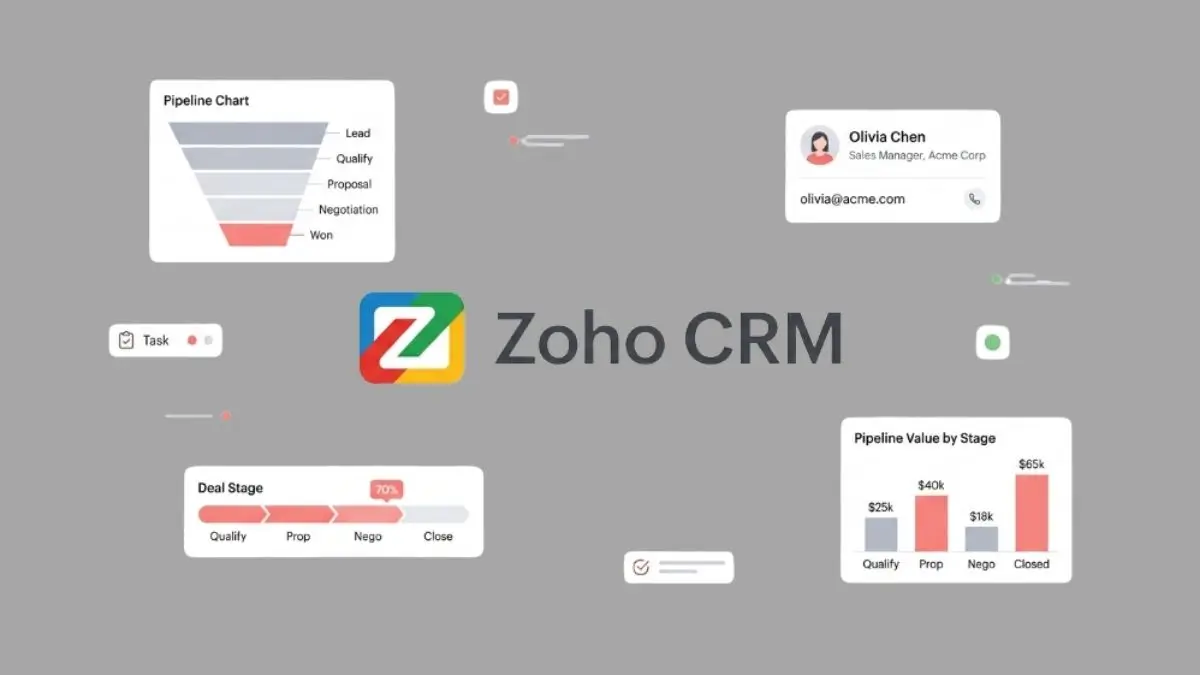
8. Zoho CRM Best Value for Mid-Sized Banks Needing Flexibility
One-line verdict: The best-value banking CRM under $25/user/month for institutions that want enterprise-adjacent capability with room to customize.
Best for: Mid-sized banks that prioritize budget, flexibility, and a large integration ecosystem over purpose-built banking features.
Pricing: Standard plan starts at $14/user/month; Professional at $23/user/month; Enterprise at $40/user/month.
Zoho CRM offers credit bureau integrations, a Canvas UI builder for banking-specific layouts, and Zia AI for predictive lead and customer scoring. KYC and AML support is partial out of the box; you’ll need to build compliance workflows using the workflow automation tools, which is achievable but requires investment. Core banking integration runs via API rather than native connectors. For institutions seeking flexibility and cost-efficiency over compliance automation, Zoho offers the strongest value proposition in this review.
- Pros: Strongest value under $25/user/month; Canvas UI builder delivers banking-specific interfaces without custom coding.
- Pros: Large integration ecosystem via Zoho Marketplace and open API covers most core banking system connections.
- Cons: Partial KYC/AML support compliance workflows require manual configuration rather than pre-built templates.
- Cons: Not banking-specific; institutions in heavily regulated environments may hit compliance gaps that require costly customization.
Softbliq Score (8.2/10)
9. HubSpot CRM Best Free Option for Small Banks Just Getting Started
One-line verdict: The smartest first CRM for a small community bank, zero cost to start, fast onboarding, and a clear upgrade path when your compliance needs outgrow the platform.
Best for: Small community banks running their first CRM and prioritizing ease of use and fast time-to-value over banking-specific compliance features.
Pricing: Free forever tier available. Paid tiers range from $15/user/month (Starter) to $130/user/month (Enterprise).
HubSpot’s free tier covers contact management, deal pipeline tracking, email automation, and basic reporting, enough for a small banking team to centralize customer data and stop losing follow-ups. What it does not cover: native KYC/AML workflows, out-of-the-box core banking system integration, or banking-specific compliance templates. Use HubSpot as your first step, with a documented plan to migrate to a banking-specific platform (360 View CRM, BUSINESSNEXT, or Creatio) as your compliance requirements mature.
- Pros: Free forever tier removes the budget barrier, with zero cost to start centralizing customer data.
- Pros: Fastest onboarding of any platform reviewed, relationship managers can be productive in 3–10 days.
- Cons: No native KYC/AML compliance workflows are not suitable as a long-term banking CRM for regulated operations.
- Cons: Core banking integration requires custom API work, which adds cost and technical complexity for small teams.
Softbliq Score (7.8/10)
10. EngageBay Best Budget-Friendly All-in-One for Small Banks
One-line verdict: A compelling all-in-one package for very small banking operations that need CRM, marketing, and help desk tools at near-zero cost.
Best for: Banks with fewer than 10 staff that need basic contact management, email automation, and customer support tools at minimal cost.
Pricing: Free forever plan available. Paid plans start at $49.99/month flat (not per user) for the All-in-One suite.
EngageBay bundles CRM, email marketing, and help desk ticketing into a single, affordable platform. For a micro-bank or a banking startup, this eliminates the need for three separate tool subscriptions. The compliance limitations are real and significant. EngageBay does not provide banking-specific KYC/AML workflows, and it is not designed for regulated financial environments. Use it as a temporary stepping stone, not a permanent compliance solution.
- Pros: All-in-one platform replaces three tools (CRM, marketing, and support) at a fraction of the cost of buying them separately.
- Pros: Flat-rate pricing (not per user) keeps costs predictable as your team grows to its first 10 members.
- Cons: No banking-specific compliance tools are appropriate as a standalone CRM for regulated banking operations.
- Cons: Limited scalability beyond small team use cases; banks that grow will need to migrate within 12–18 months.
Softbliq Score (7.2/10)
11. Practifi Best for Wealth Management Divisions Within Banks
One-line verdict: A purpose-built wealth management platform for bank divisions running private banking or financial advisory operations, not a retail banking CRM.
Best for: Bank wealth management and private banking divisions that need pre-configured workflows for client onboarding, review management, and financial advisory compliance.
Pricing: Custom pricing built on Salesforce Financial Services Cloud, so expect Salesforce-tier investment.
Practifi is a vertical overlay built on Salesforce Financial Services Cloud, which means you get the power of Salesforce’s compliance and security infrastructure, pre-configured for wealth management workflows. Client onboarding, annual review management, compliance documentation, and advisor productivity tools come configured rather than requiring custom builds. The important caveat: Practifi solves wealth management problems. A bank evaluating this tool for general retail CRM operations will find the fit poor and the cost high.
- Pros: Pre-configured wealth management workflows eliminate the months of Salesforce customization that building the same capability from scratch requires.
- Pros: Inherits Salesforce’s full compliance, security, and audit trail capabilities with a wealth-specific interface.
- Cons: Custom enterprise pricing, no self-serve transparency on costs.
- Cons: Narrow fit: only relevant for bank divisions running wealth management or private banking operations.
Softbliq Score (8.1/10)
How Do These 11 Banking CRMs Compare Side by Side?
Use this table to quickly shortlist. Focus on the columns that match your institution's top priorities.
| CRM Platform | Best For | Starting Price | KYC/A ML | Core Banking Int. | AI Features | Ease of Use | Score |
|---|---|---|---|---|---|---|---|
| Salesforce FSC | Large banks | ~$300/user/mo | ✔ Native | ✔ Strong | ✔ Agentforce | Complex | 9.1/10 |
| Creatio | Mid-sized (speed) | $25/user/mo | ✔ Strong | ✔ Good | ✔ No-code AI | Moderate | 8.8/10 |
| MS Dynamics 365 | Microsoft shops | $65/user/mo | ▲ Partial | ✔ Ecosystem | ✔ Copilot | Moderate | 8.4/10 |
| BUSINESSNEXT | AI-first banking | $15–$65/user/mo | ✔ Strong | ✔ Strong | ✔ Insight Eng | Moderate | 8.6/10 |
| Total Expert | Mortgage / Lending | Custom | ✔ Audit trails | ✔ Encompass | ✔ Data-driven | Moderate | 8.3/10 |
| Intapp DealCloud | Investment banking | 6-fig/yr | ✔ Strong | ✔ Strong | ✔ Rel. AI | Complex | 8.0/10 |
| 360 View CRM | Community banks | Custom | ✔ Strong | ✔ Strong | ✔ Actionlytics | Easy | 8.5/10 |
| Zoho CRM | Mid-sized (value) | $14/user/mo | ▲ Partial | ✔ Via API | ✔ Zia AI | Moderate | 8.2/10 |
| HubSpot CRM | Small banks (free) | Free / $15+/user/mo | ✘ Limited | ▲ Via API | ✔ Basic AI | Very Easy | 7.6/10 |
| EngageBay | Micro banks | Free / $49.99/mo | ✘ Basic | ✘ Limited | ✘ Minimal | Very Easy | 7.2/10 |
| Practifi | Wealth divisions | Custom (SF-based) | ✔ Strong | ✔ SF-based | ✔ SF AI | Moderate | 8.1/10 |
| 🏆 Winner: Salesforce FSC — Highest overall score (9.1/10) with native KYC/AML, strong core banking integration, and enterprise-grade AI via Agentforce. Best choice for large banks seeking a comprehensive CRM solution. | |||||||
Which CRM Is Right for Your Bank? (Use This Decision Framework)
The best CRM for banks is not a universal answer; it depends on your institution’s size, revenue mix, compliance complexity, and technical capacity. Use this framework to shortlist the right two or three options before you request demos.
Small Community Banks (Under 50 Staff)
Your priorities are fast go-live, ease of adoption, affordable pricing, and basic compliance coverage. Avoid enterprise platforms; you will pay for capabilities your team will never touch.
- Top picks: 360 View CRM (purpose-built for your exact situation), HubSpot (free starting point), EngageBay (all-in-one budget), BUSINESSNEXT SoHo ($15/user/month with banking features).
- Red flag: If a vendor is pitching you Salesforce FSC, Intapp DealCloud, or nCino, they are not solving your problem; they are selling you a platform designed for institutions 10x your size.
Mid-Sized Regional Banks (50–500 Staff)
Your priorities shift to compliance automation, integration depth, reporting depth, and scalability. You can afford a more complex implementation in exchange for a stronger long-term foundation.
- Top picks: Creatio (fastest enterprise deployment at scale), Zoho CRM (best value under $40/user), Microsoft Dynamics 365 (Microsoft-infrastructure banks), BUSINESSNEXT (AI transformation focus).
- Key decision: Speed-to-value (Creatio at 4–8 weeks) vs. Microsoft ecosystem integration (Dynamics at 2–4 months). The right answer depends on your existing technology stack.
Mortgage-Focused and Lending-Heavy Banks
If mortgage and consumer lending represent a material share of your revenue, the decision is clear.
- Clear winner: Total Expert purpose-built for loan officer productivity, TRID compliance, and mortgage marketing automation. No general-purpose CRM comes close to this use case. Financial advisors within banks should also review our financial services CRM software guide.
- Runner-up: Salesforce Financial Services Cloud with mortgage-specific AppExchange overlays is more expensive and slower to deploy, but more scalable for diversified large institutions.
Banks Prioritizing AI and Digital Transformation
Purpose-built banking AI outperforms horizontal CRM platforms with AI layers applied as an afterthought. Demand to see the actual ML model, not just the AI marketing language, before you sign.
Top picks: BUSINESSNEXT Insight Engine (banking-specific Next Best Action AI), Salesforce FSC with Agentforce (enterprise-grade AI + customization), Creatio no-code AI workflows.
Budget-First Banks (Under $35/User/Month)
Real options exist at every price point, but capability limits are real, too. Be honest about what you sacrifice.
| Option | Monthly Cost | Banking Features | Compliance Coverage |
|---|---|---|---|
| HubSpot Free | $0 | Basic | Minimal |
| EngageBay Free | $0 | Basic | Minimal |
| BUSINESSNEXT SoHo | $15/user/mo | Strong | Strong |
| Zoho CRM Standard | $14/user/mo | Moderate | Partial |
| Creatio Growth | $25/user/mo | Strong | Strong |
Why Do Banks Need a CRM in the First Place?
7 Signs Your Bank Urgently Needs a New (or First) CRM
If you recognize three or more of these situations at your institution, a CRM evaluation should be on your next leadership agenda:
- Relationship managers cannot see a customer’s full product history on a single screen.
- Compliance documentation still lives in a spreadsheet, and audit prep takes weeks, not hours.
- New customer onboarding takes longer than 48 hours.
- Your team avoids the CRM you already paid for and instead relies on email and spreadsheets.
- Different departments hold conflicting versions of the same customer data.
- Cross-sell opportunities surface only after a customer has already left or gone to a competitor. For more on tracking client data, see the best client reporting software.
- No one can pull a clean, examiner-ready compliance report without manually assembling data.
How CRM Reduces KYC, AML, and BSA Compliance Risk
A compliance-ready banking CRM centralizes verified customer identity documentation, automates KYC onboarding steps, flags transactions or behaviors that trigger AML review, and generates examiner-ready audit logs on demand. The practical result: compliance prep that takes weeks of manual spreadsheet work is compressed to hours of report generation. More importantly, automated workflows catch compliance gaps that manual processes miss, reducing the risk of regulatory penalties under the Bank Secrecy Act and USA PATRIOT Act before they become findings.
How Much Does a Banking CRM Really Cost?
Understanding Banking CRM Pricing Models
Banking CRM vendors use three pricing structures, and the advertised number rarely reflects the total cost your institution will pay:
- Per-user/month: The most common model (Salesforce, Zoho, Creatio, Microsoft Dynamics). Multiply the per-user rate by your full team, including staff who will access the system occasionally the number grows fast.
- Flat-rate monthly: EngageBay charges per organization rather than per user, making it ideal for small teams and advantageous if your team grows beyond 10 people.
- Custom enterprise quotes: Total Expert, 360 View CRM, Intapp DealCloud, and Practifi all require a scoped proposal. Always request an all-in quote that includes implementation fees, data migration, training, and first-year support before budgeting.
True Cost of Ownership: What Small Banks Actually Spend
Implementation and training overhead routinely multiply the sticker price. A community bank deploying a mid-market CRM platform should budget honestly for the full picture:
| Bank Size | Software License (Yr 1) | Implementation Est. | Total Year 1 Range |
|---|---|---|---|
| 10-person community bank | $5K–$18K | $5K–$25K | $10K–$43K |
| 50-person regional bank | $18K–$80K | $25K–$100K | $43K–$180K |
| 200-person institution | $80K–$300K+ | $100K–$350K | $180K–$650K+ |
The practical tip: never budget from the per-user rate alone. Platform-based implementations commonly run $50,000–$350,000 in setup costs for mid-to-large institutions. Always request an itemized, all-in quote.
How to Implement a CRM in Your Bank Without Disrupting Operations
Banks that fail CRM implementations almost always fail for the same reason: they skip the preparation steps and go straight to software configuration. Follow this sequence.
Audit Your Current Customer Data Before You Touch Anything
Data quality drives CRM success or failure. Before you migrate anything, map where your customer data currently lives (core banking system, spreadsheets, email, paper files), identify duplicates and gaps, and define your data governance rules. Garbage in, garbage out. This step is non-negotiable.
Map Your Core Workflows First
Define the exact workflows your CRM needs to support before you configure a single screen: new-customer onboarding, loan-application intake, annual-review triggers, compliance documentation, cross-sell-alert handling. Banks that start with workflow mapping cut configuration time by 30–50% compared to banks that start by exploring the CRM UI.
Shortlist CRMs That Match Your Core Banking Integration Stack
Confirm integration compatibility with your core banking system before you request a demo, not after. A CRM that doesn’t align with your core is a deal-breaker, and finding that out after a 90-day evaluation costs everyone time and credibility.
Run a Controlled Pilot With One Branch or Department
Pilot with your most engaged team, not your most skeptical one. A successful pilot generates internal champions who drive adoption across the rest of the institution. An unsuccessful pilot with resistant users derails the entire rollout.
Train Staff in Role-Based Cohorts
Loan officers need different training than branch managers, who need different training than compliance officers. Role-based training sessions run 40–60 minutes and produce higher retention than 4-hour all-staff demos. Schedule training close to go-live, not two weeks before it.
How Long Does Each Platform Take to Go Live?
| CRM Platform | Typical Go-Live | Complexity |
|---|---|---|
| HubSpot CRM | 3–10 days | Very Low |
| EngageBay | 1–2 weeks | Very Low |
| Zoho CRM | 2–4 weeks | Low–Moderate |
| 360 View CRM | 4–6 weeks | Moderate |
| Creatio | 4–8 weeks | Moderate |
| Total Expert | 4–8 weeks | Moderate |
| BUSINESSNEXT | 6–12 weeks | Moderate–High |
| Microsoft Dynamics 365 | 2–4 months | High |
| Salesforce FSC | 3–6 months | Very High |
| Intapp DealCloud | 4–8 months | Very High |
| Practifi / nCino | 6–12 months | Very High |
Frequently Asked Questions About CRM for Banks
What CRM do most banks use?
Large US banks gravitate toward Salesforce Financial Services Cloud and Microsoft Dynamics 365. Mid-sized regional banks frequently choose Creatio, BUSINESSNEXT, or Zoho CRM. Community banks and credit unions increasingly adopt 360 View CRM and HubSpot as starting points. Mortgage-focused institutions often standardize on Total Expert. The pattern is clear: institution size and revenue mix drive the CRM choice more than brand recognition does.
Do small community banks really need a CRM?
Yes, and the smaller the team, the higher the cost of missed follow-ups and siloed data. A 10-person community bank relationship manager team without a CRM loses cross-sell opportunities, struggles with audit prep, and delivers reactive service instead of proactive relationship management. The free tiers of HubSpot and EngageBay eliminate the budget excuse. There is no reason for a bank of any size to manage customer relationships in spreadsheets in 2026.
What is the difference between a banking CRM and a regular CRM?
A banking CRM includes features purpose-built for financial services: KYC/AML compliance workflows, loan tracking, 360-degree customer financial profiles, core banking system integration, and regulatory audit trails. A general-purpose CRM handles sales pipelines and contact management but requires heavy and expensive customization to meet banking regulatory requirements. The customization cost often exceeds the cost of choosing a purpose-built platform from the start.
How does a banking CRM help with KYC and AML compliance?
A compliance-ready banking CRM centralizes verified customer identity documentation, automates KYC onboarding workflow steps, flags transactions or behaviors that trigger AML review, and generates audit-ready logs on demand. The practical result: compliance prep that previously required weeks of manual work compresses to hours to complete. More importantly, automated compliance workflows catch gaps that manual processes routinely miss, reducing the risk of regulatory penalties under the Bank Secrecy Act and the USA PATRIOT Act.
What is the most affordable CRM for community banks?
HubSpot and EngageBay both offer genuine free-forever plans with enough capability for a small bank to centralize contact management and stop losing follow-ups. For banking-specific features at entry-level pricing, BUSINESSNEXT’s SoHo plan starts at $15/user/month. Zoho CRM starts at $14/user/month. 360 View CRM offers custom pricing with community bank-favorable tiers and unlimited data storage. Request a quote before assuming it is out of budget.
How long does CRM implementation take for a community bank?
HubSpot can be live in under two weeks with no IT involvement. Zoho CRM and 360 View CRM typically go live in 2–6 weeks. Creatio runs 4–8 weeks for mid-sized institutions. Salesforce Financial Services Cloud requires a minimum of 3–6 months with a certified partner. The honest rule: match the implementation timeline to your institution’s operational capacity. A 10-person community bank cannot absorb a 6-month implementation without significant disruption.
Is HubSpot CRM good enough for a bank’s long-term needs?
HubSpot is an excellent starting point, fast, affordable, and easy to adopt. It is not an adequate long-term solution for a bank with material compliance requirements. Use HubSpot to get your team off spreadsheets and centralize contact management. Build a 12–18 month roadmap to migrate to a banking-specific platform (360 View CRM, BUSINESSNEXT, or Creatio) as your KYC, AML, and audit trail requirements mature.
Conclusion: Our Final Recommendation for the Best CRM for Banks
The best CRM for banks is not the most famous one; it is the one that fits your size, budget, and compliance needs.
Simple verdict: small community banks start with 360 View CRM or HubSpot. Mid-sized banks go with Creatio or BUSINESSNEXT. Mortgage-focused banks pick Total Expert. Enterprise institutions choose Salesforce FSC.
One rule applies to every institution, regardless of size: adoption beats features every time. The CRM your team actually opens every morning will always outperform the expensive one collecting dust on a server.
Choose smart. Start simple. Scale when ready.